
Applications
Roll Forming Machines for Warehouse Racking Manufacturers
For racking and shelving manufacturers: these are the production applications our roll forming lines serve. Sanli builds the machines, while the racking systems themselves are designed, built and installed by our customers.
Where the profiles end up
Five storage applications, five profile sets
The same upright line can serve a selective racking plant and an automated warehouse — what changes is the profile drawing, the strip thickness and the tolerance the system can live with. These five cover almost every inquiry that reaches us.
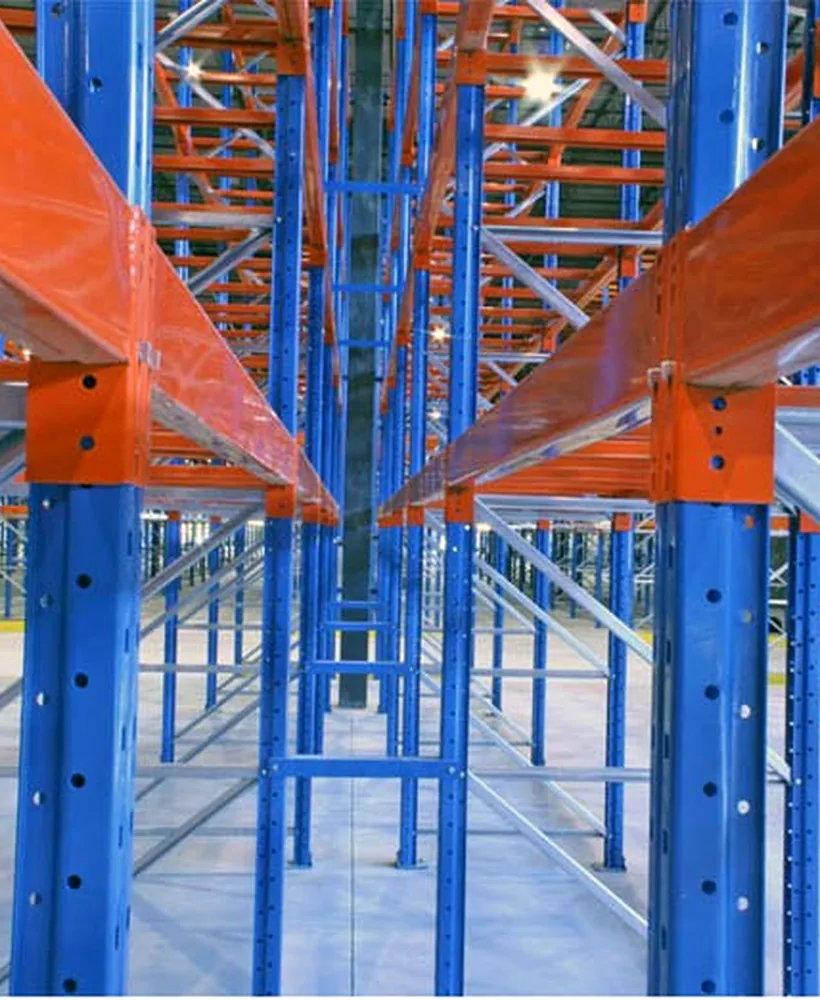
Machines for Selective Pallet Racking
The most common storage system in any warehouse: every pallet sits on its own pair of beams and can be picked without moving another. The frame is an upright-and-bracing assembly; the load level is a pair of beams with the beam-to-upright connector punched in line.
- Perforated uprights — 1.5–3.0 mm strip, slot pattern punched during forming
- Beams — box beam 1.5–1.8 mm or step beam 1.2–1.6 mm
- Bracing — horizontal and diagonal channels, 1.4–1.8 mm
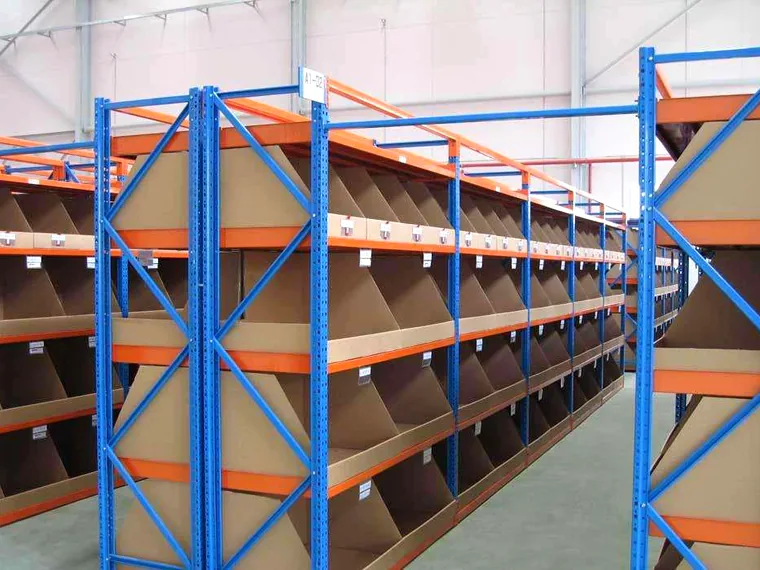
Machines for Heavy Duty Warehouse Racking
Higher bays and heavier pallets push the section sizes up. Uprights run to the top of the strip range at 3.0 mm, beams go to the deeper box sections, and the frame bracing carries more shear. What does not change is the slot pitch — the beam connector has to fit the same upright whatever the load.
- Heavy-gauge uprights — up to 3.0 mm strip, 18 forming stations
- Box beams — 1.5–1.8 mm, in-line punching and cut-off
- Frame bracing — sized to the bay height and load
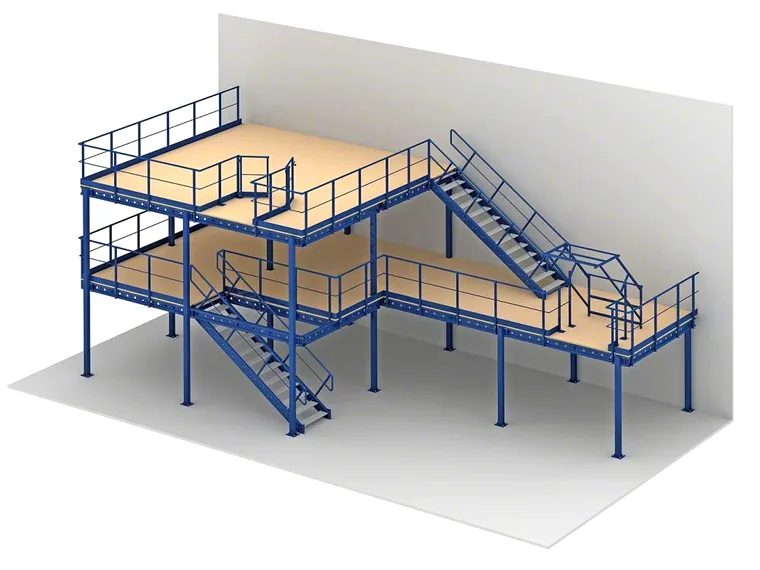
Machines for Mezzanine and Platform Racking
Mezzanine and multi-tier installations turn racking into a building: a raised floor carried on the same upright frames, reached by stairs or a lift. The profiles are the same family as pallet racking, but the platform needs its own beam and deck set, and the bracing has to suit the open bays left for access.
- Platform beams — box beam sections at 1.5–1.8 mm
- Deck panels — shelf panel profiles, 0.4–1.2 mm
- Bracing — configured around access openings
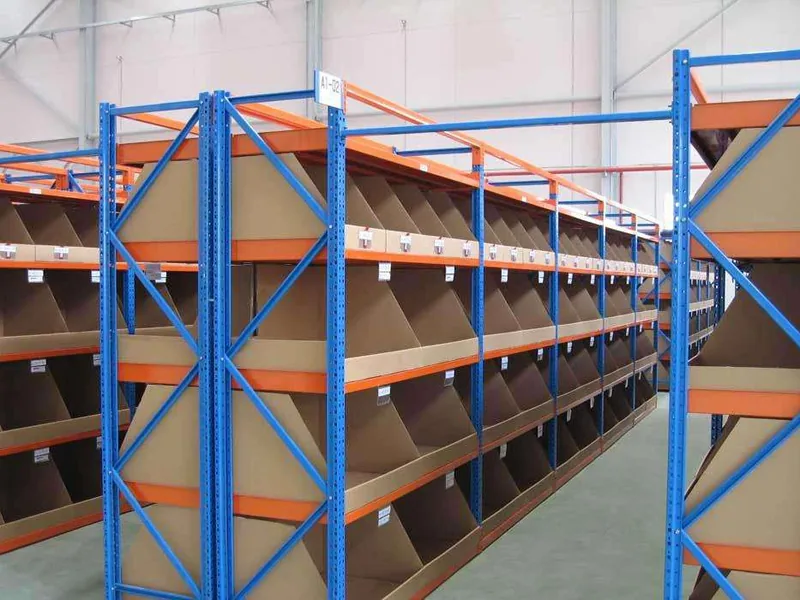
Machines for Warehouse Shelving
Shelving, longspan and multi-tier shelving run on much thinner material than pallet racking. Panels are formed from 0.4 mm strip upward, with stiffeners and support bars added for span. A shelf panel line typically combines punching, forming and two-side bending so the panel leaves the line ready to fit.
- Shelf panels — 0.4–1.2 mm strip, punched and bent in line
- Stiffeners and support bars — formed to the panel span
- Angle uprights — slotted or plain, per system design
Application 05
Machines for Automated Warehouse Racking
In AS/RS, shuttle and miniload installations the rack stops being a shelf and becomes a machine interface. A pallet that will not enter its channel is usually a fraction of a millimetre out at the slot pitch, not a damaged beam. That is where profile consistency and punch repeatability decide whether the system runs.
See the upright line-
Profile consistency end to end
18 forming stations on the upright line, with the finished profile checked against the drawing before shipment.
-
Punch repeatability
Slot and hole patterns punched in line, so the pitch stays constant from the first metre of the coil to the last.
-
Beam-to-upright fit
Upright and beam profiles are specified as a pair when the system needs a defined connector fit.
Component map
Which line forms which part
| Rack component | Formed on | Strip thickness | Typical system |
|---|---|---|---|
| Upright | Rack upright line | 1.5–3.0 mm | Selective, heavy duty, AS/RS |
| Box beam | Box beam line | 1.5–1.8 mm | Selective, heavy duty |
| Step beam | Step beam line | 1.2–1.6 mm | Selective, longspan |
| Bracing | Bracing line | 1.4–1.8 mm | Every frame-based system |
| Shelf panel | Shelf panel line | 0.4–1.2 mm | Shelving, multi-tier |
| Custom profile | Custom line | Per drawing | Non-standard systems |
End users
Where the racking ends up
Sanli supplies the machine, not the rack — but knowing where the rack is installed tells us what the profile has to survive.
-
Warehousing & distribution
Selective and high-bay pallet racking for third-party logistics and distribution centres.
-
Manufacturing & industrial
Storage for raw material, work in progress and finished goods inside production plants.
-
Cold & ambient storage
Racking for chilled and frozen rooms, where section sizes and coatings are specified for the environment.
-
3PL & e-commerce fulfilment
Shelving, longspan and multi-tier systems for mixed-SKU picking operations.
Tell us the system, we will specify the line
Send the rack profile you need to produce, the strip thickness and the output per shift. Our engineers in Wuxi will come back with a configuration and a price.