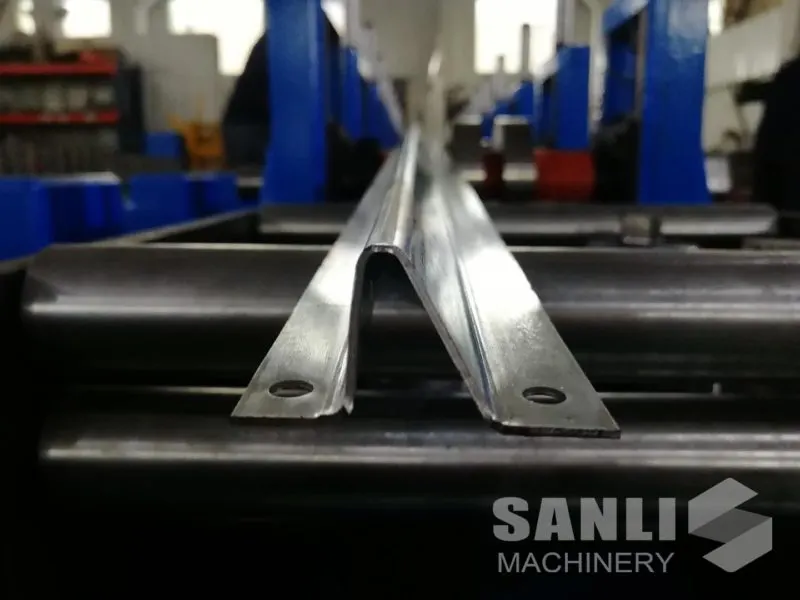
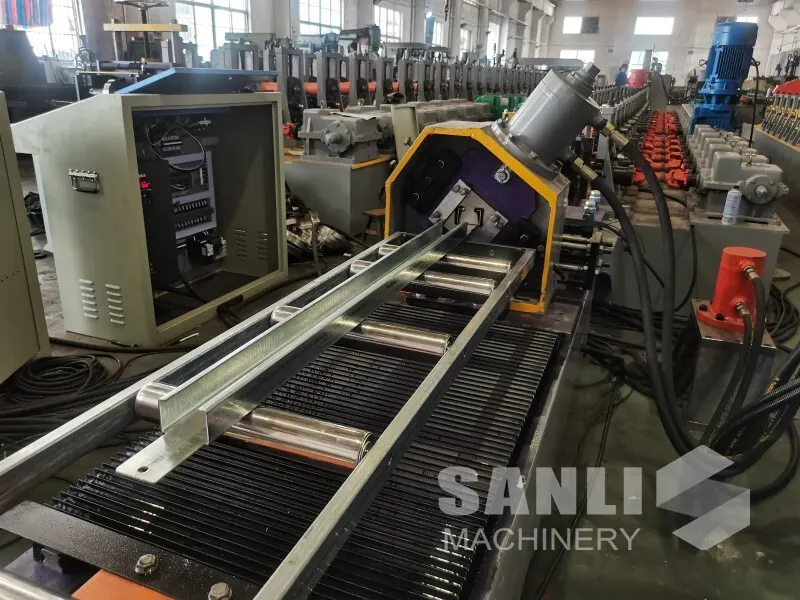
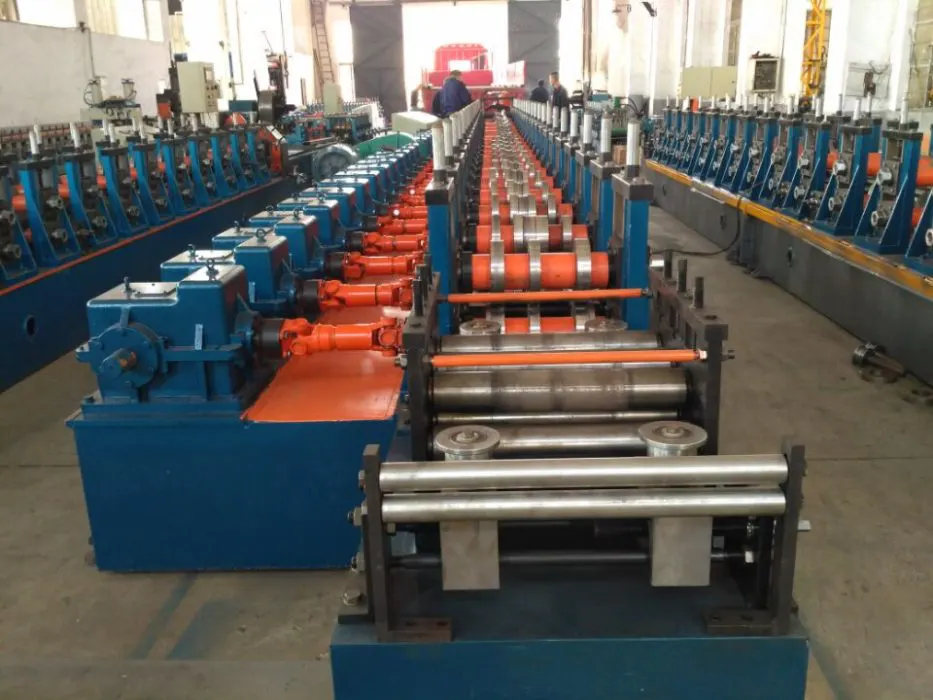
Rack rivet beam roll forming machine produces the beam that fixes to the upright with rivets rather than hooks or bolts, a common fitting on lighter-duty and boltless shelving systems. The line forms 1.5-1.8 mm strip through 15 stations with a 15 kW main motor at up to 15 m/min. Rivet holes are punched in line, so hole pitch is set by tooling rather than by a second operation.
Rack Rivet Beam Roll Forming Machine is used to produce rack rivet beams for warehouse pallet rack system, which support for pallet racks to assure the racks have adequate support for the weight of the products stored on them, ensuring they don’t bow or create an unsafe condition. The rack rivet beams manufactured by our rack rivet beam roll forming machine are available in multiple lengths and with different dimensions suitable for almost any warehouse layout and product mix. The right beams allow you to store material safely and securely while allowing complete accessibility for material handling equipment.
Sanli Machinery is one of the leading rack roll forming machine manufacturer in China. During the past 20 years, Sanli Machinery has already designed and manufactured more than 50 sets of rack rivet beam roll forming machines for customers around the world.
Three decisions that change the machine, and how to tell which side of each one you are on.
01
Rivet pitch is tooling, unless you pay for servo
The rivet pattern has to line up with the upright hole pattern, and that pattern differs between rack families. With a fixed punch the pitch is cut into the tooling, so a new family means a new punch set. Servo punching sets the pitch from the recipe instead, which is worth it where a plant builds more than one boltless family and wasted money where every job uses the same upright.
02
Rivet beam, or hook beam
The fitting decides the line. A rivet beam needs rivet holes on a pitch that matches the upright, and the section is usually lighter because riveted systems are sold for lighter duty. A hook beam needs the hook formed into the end of the beam instead. They are not interchangeable, and a plant that sells both needs both roll sets, not both lines.
03
Where the 1.8 mm ceiling bites
This line covers 1.5 to 1.8 mm, which matches boltless shelving but not heavy pallet racking. If a job arrives at 2.0 mm the beam has to go elsewhere, so check the thickest section in your catalogue before ordering rather than after the first enquiry. The alternative is a wider-gauge beam line, which costs more and runs slower on the thin work that makes up most of the volume.
Working flow
How the line runs
01
Decoiling
Coil is mounted and strip fed into the line. Rivet beam runs 1.5 to 1.8 mm strip on a 15 kW motor at up to 15 m/min.
02
Feeding and guiding
Strip is levelled and guided. The rivet holes are what locate the beam in the upright, so strip alignment at entry decides whether the rivet pattern lands on the centre line.
03
Punching
Rivet holes are punched in the flat strip. Pitch and diameter are set by the tooling, because the rivet itself is a purchased part and the beam has to match it.
04
Roll forming
15 stations form the beam section. The section is formed progressively with the hook geometry in the middle group and calibration at the exit.
05
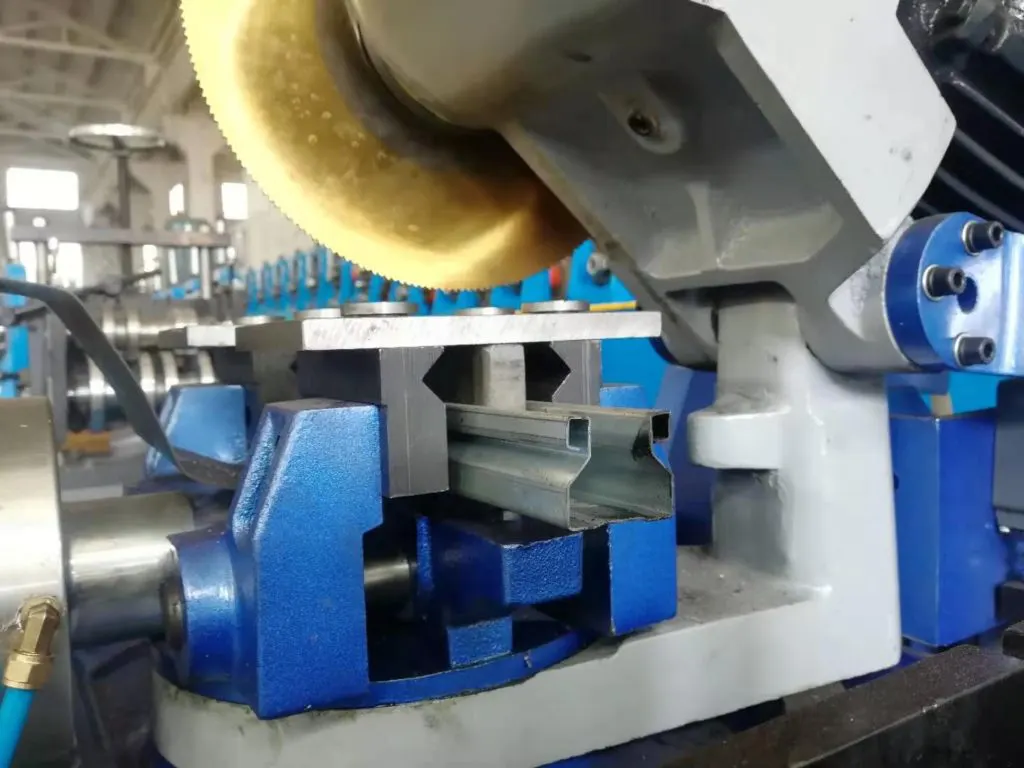
Cutting
A hydraulic cut-off shears the beam to length. Length is a recipe value, so a range of beam lengths runs off one tooling set.
06
Run-out
Beams leave on an out table and go to riveting, which is a separate operation. This line forms and punches the beam; it does not insert the rivets.
Scope and options
What can be added to the line
Riveting is a separate station. These options cover what the forming line itself can be asked to do.
01
Servo punching
Changes rivet pitch from the recipe instead of from the tooling. Rivet patterns follow the upright hole pattern, which differs between rack families.
02
Second roll set
A spare set for a second beam height. Boltless shelving systems are usually sold in more than one beam size.
03
Hydraulic decoiler
Speeds coil changes. Rivet beams are short parts, so coils run out quickly.
04
Pre-piercing for the rivet
Adds a second punch station so the rivet hole and the locating hole are made in one pass, which removes a second handling step.
Before you order
Questions buyers ask before ordering
How much does a rack rivet beam roll forming machine cost?
The price is set by whether rivet pitch is fixed or servo-set, how many beam heights the line covers, and the coil handling. The 15 stations and the 15 kW motor stay the same. Beam length is a control value and costs nothing. If you build more than one boltless family, price the servo punching with the line: a second fixed punch set bought later costs more than the option did.
What is the difference between a rivet beam and a hook beam?
The fitting. A rivet beam is fixed to the upright with rivets through holes on a pitch that matches the upright pattern, so the holes have to be punched in line. A hook beam has the hook formed into its end and engages a slot. Riveted systems are normally sold for lighter duty, which is why this line stops at 1.8 mm rather than running to 2.5 mm.
Can it punch the rivet hole and the locating hole in one pass?
With the pre-piercing option, yes. Standard builds punch one pattern per pass, which means a second handling step for the locating hole. Adding a second punch station puts both holes in one pass and removes that step, and on a part this short the handling is a large share of the cycle, so the option usually pays for itself. It is ordered with the line rather than added later, because a second station changes the frame.
How fast does it run?
Up to 15 m/min on 1.5 to 1.8 mm strip. Real output is set by the punch and the cut rather than by the forming speed, because a rivet beam is a short part: the line accelerates, punches, cuts and stops far more often than a beam line running long lengths. That is also why coil changes come round quickly on this section.
What is the delivery time?
Around 50 to 65 days from deposit for a single-height line with a fixed punch. Servo punching adds about two weeks because the punch drive and the control have to be lined up with the existing axis. Sea freight is 25 to 35 days to most ports, and the line is run on your strip before packing. Beam height and the upright hole pattern are confirmed before the punch is cut, and a fixed pattern ordered against the wrong upright is a scrapped punch set.
Include the strip thickness, the coil width and the output you need per shift. Our
engineers in Wuxi will review it and come back with a configuration and a price.