
Philippines · 2021
A Fully Automatic Upright Line in the Philippines
Decoiler to run-out as one sequence, a 100 t press ahead of the forming stands, and an acceptance run that measured the sample, not the demo.
- Market
- Philippines
- Delivered
- 2021
- Customer
- A racking manufacturer
- Main machine
- Rack Upright Roll Forming Machine
A rack upright line was delivered to a customer in the Philippines in March 2021. It runs decoiler through to run-out table as one continuous sequence under PLC control, with the control box governing length, batch count and punch cycle.
The line as delivered
The sequence is decoiler, leveler, servo feeder, 100 t press, main forming machine, hydraulic cutting, run-out table. Two stations in that sequence do work that is easy to underestimate.
The leveler removes coil set — the curvature the strip retains from being wound — before the strip reaches the first forming station. Without it, the strip enters the rolls already curved, the section comes out bowed, and no amount of roll adjustment afterwards will straighten it fully. It is the cheapest component to leave out and the most expensive one to leave out.
The servo feeder feeds by measured length rather than against a stop, which is what keeps the punch pattern in register with the cut on every piece in a batch. On a line with a fixed stop, register drifts over a run and is corrected by the operator; on a servo feeder it does not drift in the first place.
Why 100 t on an upright line
The upright needs tear-drop or butterfly holes plus slots down its face, and those are punched in the flat strip before forming. Press tonnage is set by the largest slot the drawing calls for and by the strip thickness, with margin for the tool to hold its stroke without deflecting.
A press that is marginal on tonnage will still make holes. They will just be slightly out of position on one side of the strip, and that error becomes a beam that will not seat — which surfaces at the customer’s assembly line, not at the machine. The tonnage margin is not for the average hole, it is for the worst one on the drawing.
How the line was accepted
An upright line is usually accepted on a sample rather than on a demonstration, and the difference is worth stating plainly: a demonstration shows that the machine works, a sample shows that it produces a part to drawing. The checks that matter:
- Section dimensions measured at the start, middle and end of a full length — not on a short offcut.
- Hole pitch measured over ten consecutive holes, not over one gap.
- Hole-to-edge distance, which decides whether the hook tears out under load.
- Straightness with the finished upright laid on a flat surface.
- Cut squareness, since the upright is butted against the frame jig at both ends.
Five measurements, all of which can be made with a tape and a straight edge in an afternoon, and all of which are difficult to argue about later if they were written down at acceptance.
After delivery
The machine ships broken down into container sections, with the control cabinet and hydraulic station crated separately and the roll settings recorded from the test run. That record is the reference for every coil change afterwards: it turns “the section looks a bit off” into a measurement against a known setting.
The numbers
- Press
- 100 t
- Sequence
- Decoiler to run-out
- Control
- PLC, length and batch
- Accepted
- sample measured
What was in the line
-
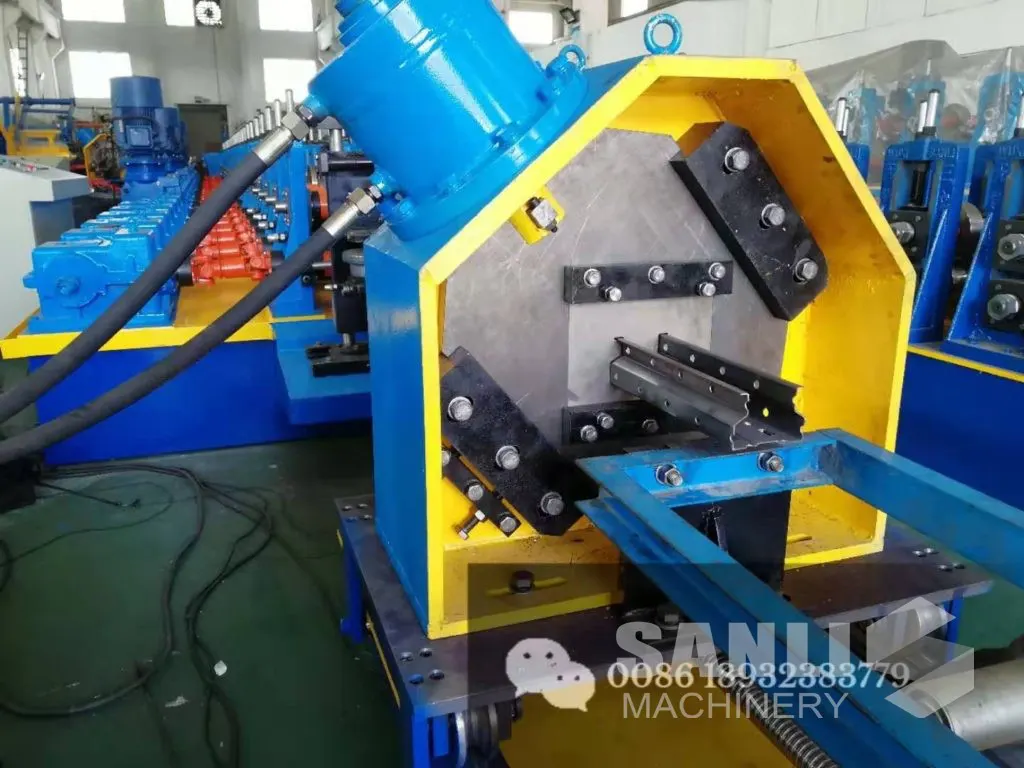
Rack Upright Roll Forming Machine
Rack Upright Roll Forming Machine (also called Omega-Racking Upright Roll Forming Machine) is used to produce rack upright for Warehouse Pallet Rack
View machine
Decoiler, leveler, servo feeder, 100 t press, forming, hydraulic cutting and run-out under one PLC.
Tell us the profile and we will size the line
Section drawing, strip thickness, material grade and the output you need per shift — that is enough for us to come back with a machine specification and a price.