
United States · 2021
4,000 Bracing Pieces a Shift: Servo Follow Cutting in the US
A bracing line in a US workshop runs 480 V / 60 Hz and cuts on the move. Servo follow cutting is what separates 4,000 pieces a shift from 1,300.
- Market
- United States
- Delivered
- 2021
- Customer
- A racking manufacturer
- Main machine
- Rack Bracing Roll Forming Machine
A bracing line has been running in a customer’s workshop in the United States, producing around 4,000 bracing pieces in an eight-hour day. The number that matters is not 4,000. It is the 1,300 the same line would produce with a stop-cut head.
What servo follow cutting changes
On a stop-cut line the strip stops, the cut is made, and the strip starts again. Every piece carries an acceleration and a deceleration, and on a light, short, fast profile those stops are a large share of the cycle.
Servo follow cutting removes them. The cutting head travels with the strip, makes the cut while moving, and returns for the next piece without the line ever stopping. On bracing the difference is large precisely because the part is short: the shorter the piece, the higher the share of the cycle the stop occupies, so the more there is to recover.
The forming speed is the same on both builds. The cutting method is what separates 1,300 pieces from 4,000, which is worth remembering when two quotes for a bracing line differ mainly in price — the cheaper one is usually a different cutting arrangement, not a cheaper version of the same machine.
Why bracing suits this
Bracing is a light, short, high-volume part, which makes it the part where cutting dominates cycle time. It is also the part where a stop-start line is hardest on the machine: every stop puts a load reversal through the drive and the roll train, and on a thin section that shows up as marking on the strip and as wear on the guides.
So removing the stops is a durability measure as much as an output measure. A plant that runs bracing on a stop-cut line and wonders why guides wear faster than expected is usually looking at a cutting decision, not a maintenance problem.
The line as installed
The machine is built as decoiler, main forming machine, hydraulic punch, hydraulic cut, run-out table and control box. Punch and cut are both hydraulic, which keeps the tooling compact on a narrow section and lets the two be sequenced from the PLC rather than mechanically.
The standard bracing range runs 13 forming stations at 15 m/min with GCr15 rollers and 40Cr shafts. Thirteen is a modest station count because bracing is a simple section. The engineering in this line sits in the cut and the punch, not in the forming.
Two requirements a US installation adds
A US installation carries two practical requirements beyond the machine itself. The first is the electrical supply: US plants run on 480 V / 60 Hz, so the control cabinet, motors and heaters are specified for that supply rather than for the 380 V / 50 Hz used elsewhere. Retrofitting a 50 Hz machine to a 60 Hz site is not a plug change — motors, heaters and drives all have to be reconsidered.
The second is support. Spare parts and documentation have to be reachable from the same continent as the machine, because a bracing line stopped for a bearing is a line producing nothing. Both are settled at order stage; neither can be fixed afterwards without cost.
What to ask before ordering a bracing line
Ask what the cutting arrangement is before asking for a price, because it decides the output more than any other single item. Then ask how many pieces per shift the quoted build produces on your own bracing length — not on a metre-per-minute figure, which hides the cut cycle entirely.
The numbers
- Output
- ~4,000 / 8 h
- Stop-cut equivalent
- ~1,300 / 8 h
- Stations
- 13
- Supply
- 480 V / 60 Hz
What was in the line
-
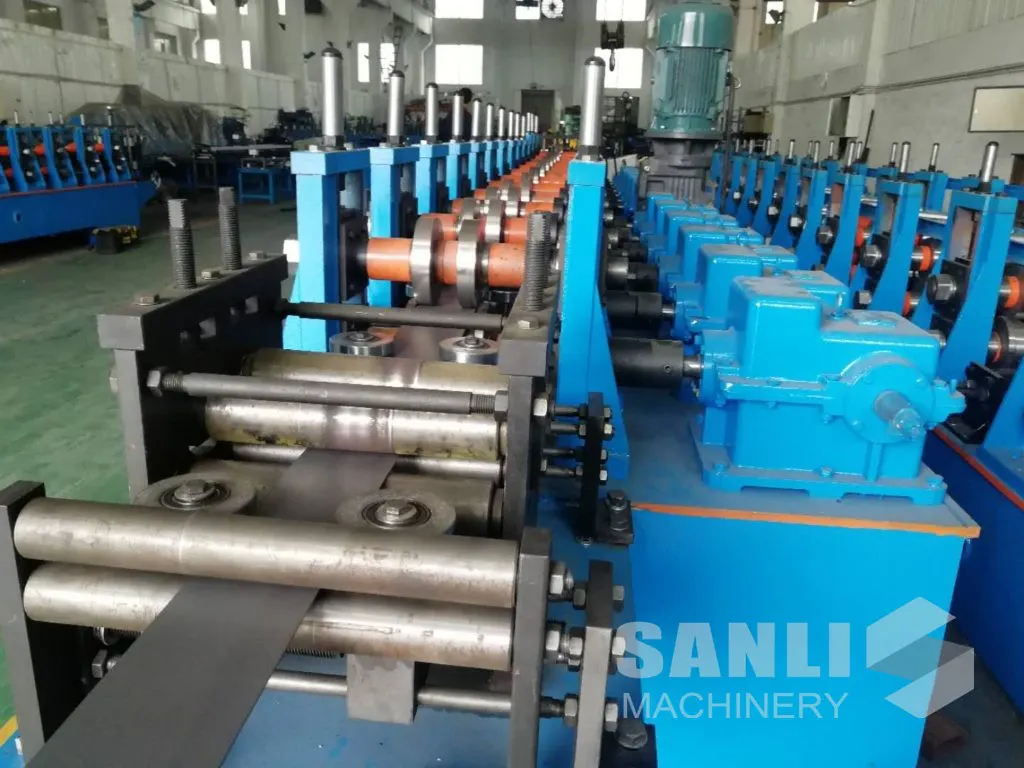
Rack Bracing Roll Forming Machine
Rack Bracing Roll Forming Machine is used to produce rack bracing (also called diagonal bracing) for warehouse pallet rack system, which is the
View machine
Built to 480 V / 60 Hz for the US supply, with hydraulic punch and hydraulic cut sequenced from the PLC.
Tell us the profile and we will size the line
Section drawing, strip thickness, material grade and the output you need per shift — that is enough for us to come back with a machine specification and a price.