
Comparison · where the holes are made
In-line vs Post Punching for Rack Uprights
In-line punching puts the punch station inside the roll forming line, so the strip is punched flat, formed and cut to length in one pass. Post punching forms the column first and punches it afterwards on a separate press. The difference is not speed — it is which surface the holes are measured from, and how much tooling you own per hole pattern.
- Punch position
- before forming
- Punch die material
- SKD11
- Thickness range
- 1.5 – 3.5 mm
- Hole types
- tear-drop, butterfly, slot
What in-line punching actually does
The strip is punched flat, before the forming stands, while it is still a continuous flat band. Then it is formed, then cut to length. Punching flat is easier than punching a formed column in every respect: the die sits on a flat surface, the burr direction is consistent across the strip, and the strip is located by the feed rather than by a fixture built around a section.
The forming passes that follow stretch the pattern slightly, and the tooling is set to compensate for that stretch. It is a property of your section rather than of the machine, so it is measured once and built into the punch tool — which is why the first-article check on a new upright always includes the hole pitch on the finished column, not only on the flat strip.
The datum problem
On-line, every hole is positioned relative to the cut length. The line measures the strip and cuts where the register says, so the last hole and the cut end stay in the same relationship for the whole coil. Post punching, the column is measured from one end against a stop or a fixture, and every column starts its own measurement error from zero.
Neither method is more accurate in principle. What differs is that in-line punching holds the whole pattern as one system, while post punching holds each hole to a fixture. On a 3 m column carrying forty holes, one system against forty fixtures is the difference that decides whether a bay assembles.
Tooling is the real cost of in-line
Every hole pattern needs its own punch set. The sets we supply are SKD11 with an inserted lower die, covering 1.5 – 3.5 mm upright thickness and any layout on your drawing: tear-drop, butterfly, slot or a mix. A plant with two patterns owns two sets. A plant with six owns six, and that is a real number to put against the labour the line saves.
Post punching needs a press and one tool per pattern, and the press can be loaded while the line runs. That flexibility is what makes post punching viable for a plant whose order book is many patterns at low volume — the tooling bill stays small and the changeover is a press setup rather than a line stop.
The comparison in one table
In-line against post punching for rack uprights
| Aspect | In-line punching | Post punching |
|---|---|---|
| Where the holes are made | In the line, before forming | On a press, after forming |
| Datum | Cut length register | The cut end or a fixture |
| Tooling per pattern | A punch set, owned per pattern | A press tool per pattern, plus the press |
| Handling | Coil in, cut length out | Every column passes through a second machine |
| Changeover | The line stops for the tooling change | The press runs ahead of or behind the line |
| Fits best | One or two patterns in volume | Many patterns, short runs |
Hole position tolerance is not the deciding factor in either case; the datum and the tooling bill are.
Pre-galvanised coil changes the answer
Punching pre-galvanised strip cuts through the zinc coating, so every hole leaves a bare edge. On a cold store or outdoor installation that edge is the first place to rust, and it has to be touched in with a zinc-rich coating before assembly. That is true of both processes — a punched hole is a punched hole — but in-line punching makes it a step in the line rather than a separate operation, which is where plants usually forget it.
The alternative is hot-dip galvanising after forming and punching, which closes the edge properly and costs a process step, a re-straightening risk and a lead time. Neither route is free. The decision belongs with the coating specification, not with the machine.
What to ask before choosing
- How many hole patterns are in production now, and how often does one change?
- Is the pitch functional — does a connector lock into it — or is it only locating?
- Does your customer inspect hole position on the flat strip or on the formed column?
- Who holds the punch tooling drawing, and does it travel with the machine?
- Will the uprights be painted or galvanised, and what happens to a bare punched edge?
The answers decide the configuration more reliably than a price comparison does. In practice: one or two patterns in steady volume points at in-line punching with a spare tooling set; five or more patterns at low volume points at post punching with the line running flat-out on forming alone.
Machines for this job
The builds that cover it
Each of these is a standard build quoted against your drawing, not a catalogue item. Where none of them fits, the custom range starts from the same components.
-
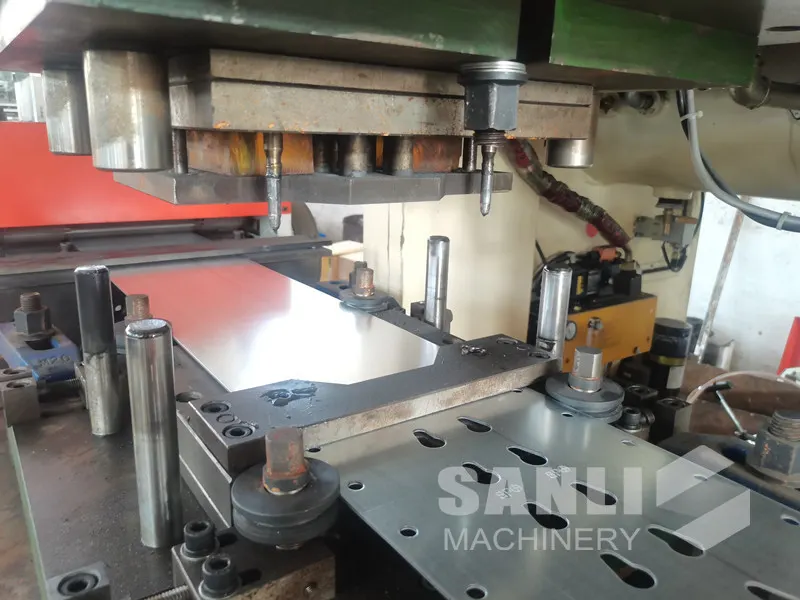
Punch Mould for Rack Upright
The tooling itself: SKD11 dies with an inserted lower die, 1.5 – 3.5 mm, on-line or off-line.
View machine -
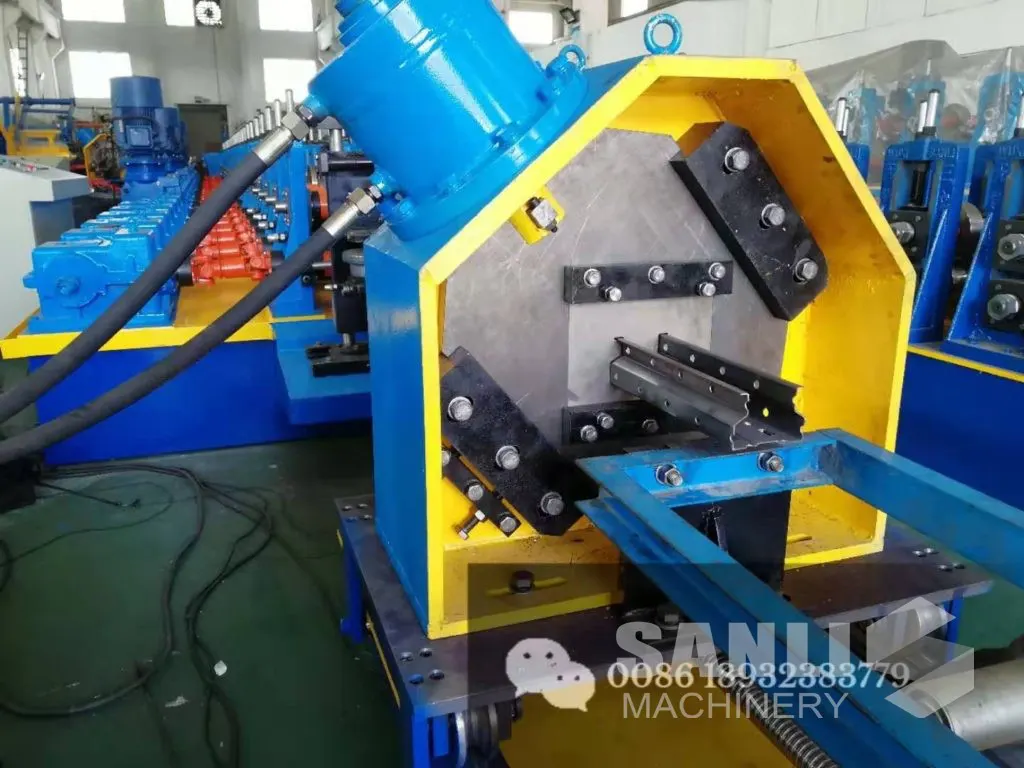
Rack Upright Roll Forming Machine
The line with a punch station: 1.5 – 3.0 mm, 18 stations, 15 kW, punched before forming.
View machine -
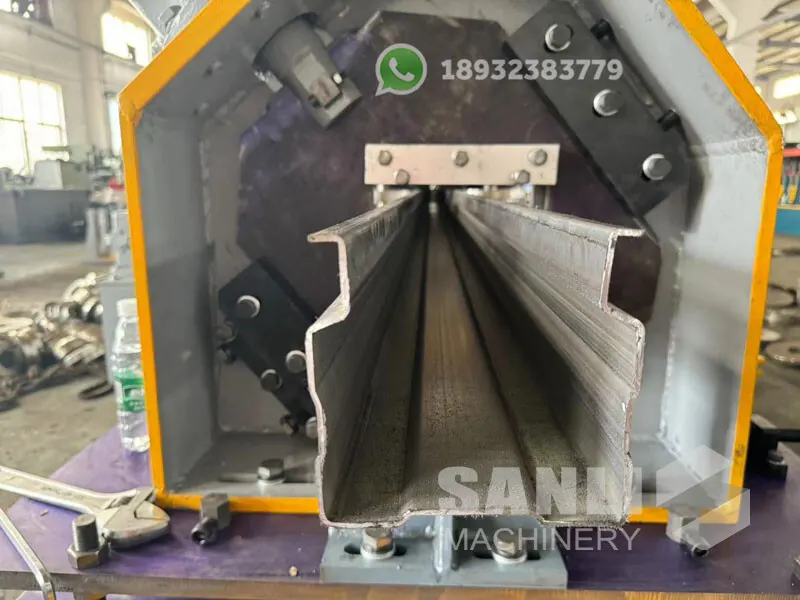
Heavy Duty Rack Upright Roll Forming Machine
The heavier in-line build: 2.0 mm selective racking, 20 stations, twin 22 kW, gearbox drive.
View machine
The other side
When in-line punching is over-bought
In-line punching is the better answer for most upright production. These are the cases where it is not.
Six or more patterns at low volume
Every pattern needs its own punch set, and the line stops for each change. At that point a press beside the line is cheaper to own and easier to schedule.
The pattern is still being changed by your customer
A punch set is made to a drawing. A customer who revises the layout twice a year is asking you to buy the tooling twice. Punch off-line until the layout settles.
The uprights are hot-dip galvanised anyway
If the parts go through a zinc bath after forming, the hole edge is closed by the coating and the in-line datum advantage is the only remaining benefit. Weigh it against the tooling bill.
Before you order
Questions this page usually raises
Can the line punch tear-drop and butterfly holes in one station?
Yes, where the layout puts them on the same pitch. A punch station carries several tools across the strip width, and one stroke makes all the holes in that row. Layouts with holes on different pitches need either a second station or an indexing arrangement, which is a question for the tooling drawing rather than a limit of the line.
Does punching before forming distort the holes?
Forming stretches the pattern slightly, and a tear-drop that closes up is the usual symptom of too little punch clearance. The tooling is set to compensate for the stretch of your section, and the check is the same every time: measure the pitch flat, measure it formed, and sign the first article before the balance of the order runs.
Can on-line punching be added to an existing line later?
It can, and it usually costs more than specifying it at order: the line needs length for the punch station, the hydraulics need capacity, and the control has to integrate a station that was not in the original programme. If punching is likely within a year or two, put it in the first order.
Which is more accurate, in-line or post punching?
In-line holds the pattern to the cut length, which is what a connector cares about. Post punching holds each hole to a fixture, which is accurate hole by hole but accumulates error along the column. If your customer inspects a bay rather than a part, in-line is the safer answer.
Other selection guides
Selection guides
Head to head
Send the drawing and the output you need
The section drawing, the strip grade and the pieces per shift are enough to specify the machine — and enough to tell you if a different configuration would serve you better.