
Investment · line configuration
Roll Forming Line or Standalone Machine
A standalone machine forms the section and leaves you to handle coil and punch separately; a line takes coil at one end and delivers cut-to-length parts at the other. The forming section can be identical in both. What changes is coil handling, punching, cut-off, run-out, floor length and how many people it takes to run.
- Line sections
- 5 – 6
- Operators, line
- 1 – 2
- Operators, standalone
- 2 – 3
- Decided by
- Volume and changeover
What the word line actually covers
A rack roll forming line is a sequence of sections quoted together: decoiler and coil car, leveler and servo feeder, punching station, forming section, cut-off, and run-out or stacker. A standalone machine is the forming section on its own, with coil fed from a separate decoiler and holes punched either before or after on a press.
Because the forming section can be the same in both, a quote for a line and a quote for a standalone machine are not directly comparable — one includes five sections the other does not. Compare the section list first, then the price.
Three configurations, section by section
| Configuration | Included | Left to you | Best for |
|---|---|---|---|
| Standalone former | Forming section, cut-off | Coil handling, leveling, punching | Low volume, or punching already covered by a press |
| Semi-automatic line | Decoiler, leveler, feed, punch, former, cut-off | Run-out, stacking, coil loading | The common upgrade; one operator plus a helper |
| Automatic line | All six sections, closed-loop control | Nothing between coil and cut length | Volume work where labour is the constraint |
An automatic build adds coil handling and end-to-end control rather than a faster forming section.
Floor length before price
A line is laid out end to end, and the length is the specification most likely to be discovered too late. Add it up from the sections: decoiler and coil car, leveler and feeder, punch, forming stands, cut-off, run-out — and then add the coil storage and the fork-lift turning circle in front of the decoiler. A standalone former fits into a fraction of that, which is often the real reason a plant buys one.
Measure the hall before the quotation, not after. If the length is tight, the honest options are a shorter run-out, a coil car instead of a coil ramp, or a semi-automatic line that leaves stacking to a separate station. Each of those is a quote change, not a site change.
- Hall length from the coil storage position to the end of the run-out.
- Headroom for the coil car and for lifting coils onto the decoiler.
- Floor loading where the decoiler and the former stand.
- Access for a fork-lift to remove finished bundles from the run-out.
People, and what the line replaces
A standalone setup needs someone at the former, someone at the press and someone moving parts between them. A line run from coil to cut length needs one operator and, at volume, a helper on the run-out. That difference in headcount is usually what justifies the extra sections, not the speed.
Where the line also wins on quality is the datum. On-line punching holds the hole pattern to the same reference as the cut length; a separate press holds it to whatever the operator sets against. For uprights, where the hole pattern is what the beams lock into, that is a functional difference rather than a convenience.
Machines for this job
The builds that cover it
Each of these is a standard build quoted against your drawing, not a catalogue item. Where none of them fits, the custom range starts from the same components.
-
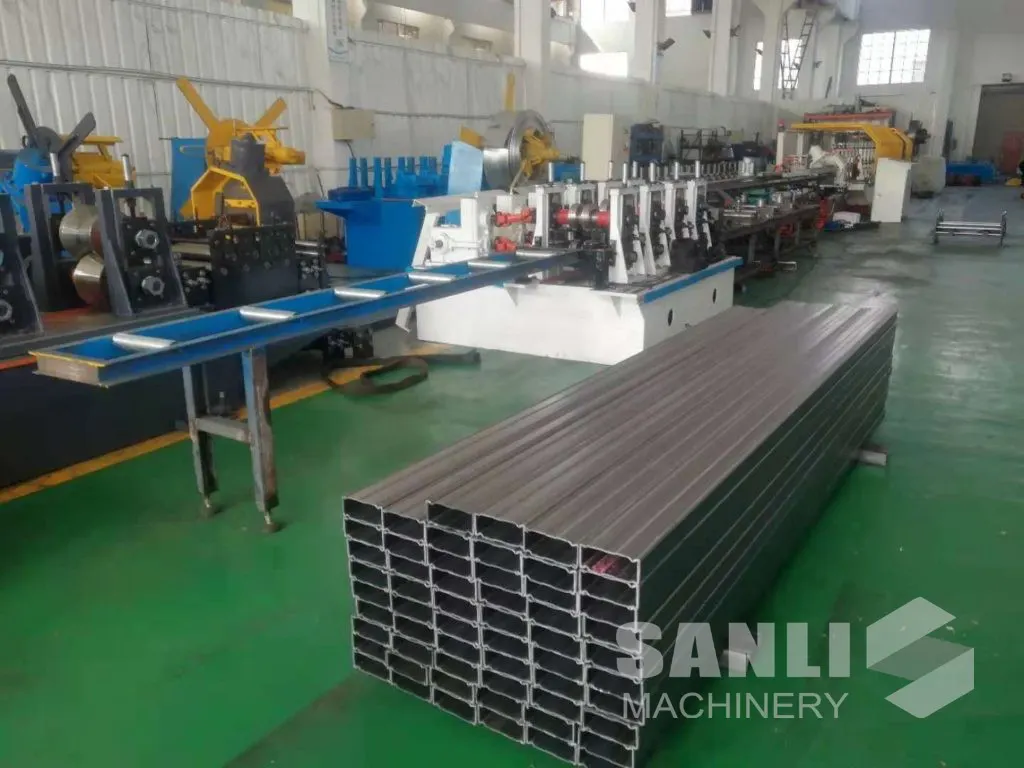
Fully Automatic Rack Box Beam Roll Forming Machine
The automatic case: 1.5 – 2.0 mm, 16 stations, coil to cut length with one operator.
View machine -
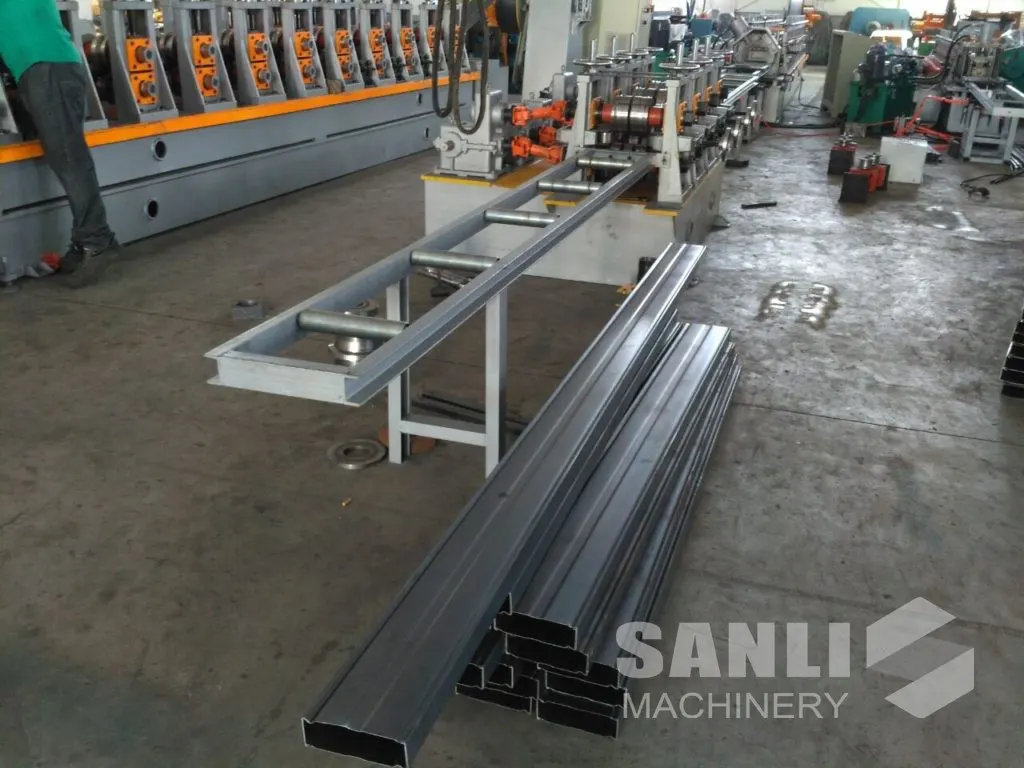
Rack Box Beam Roll Forming Machine
The semi-automatic case: 1.5 – 1.8 mm, 14 stations, 22 kW, up to 15 m/min.
View machine -
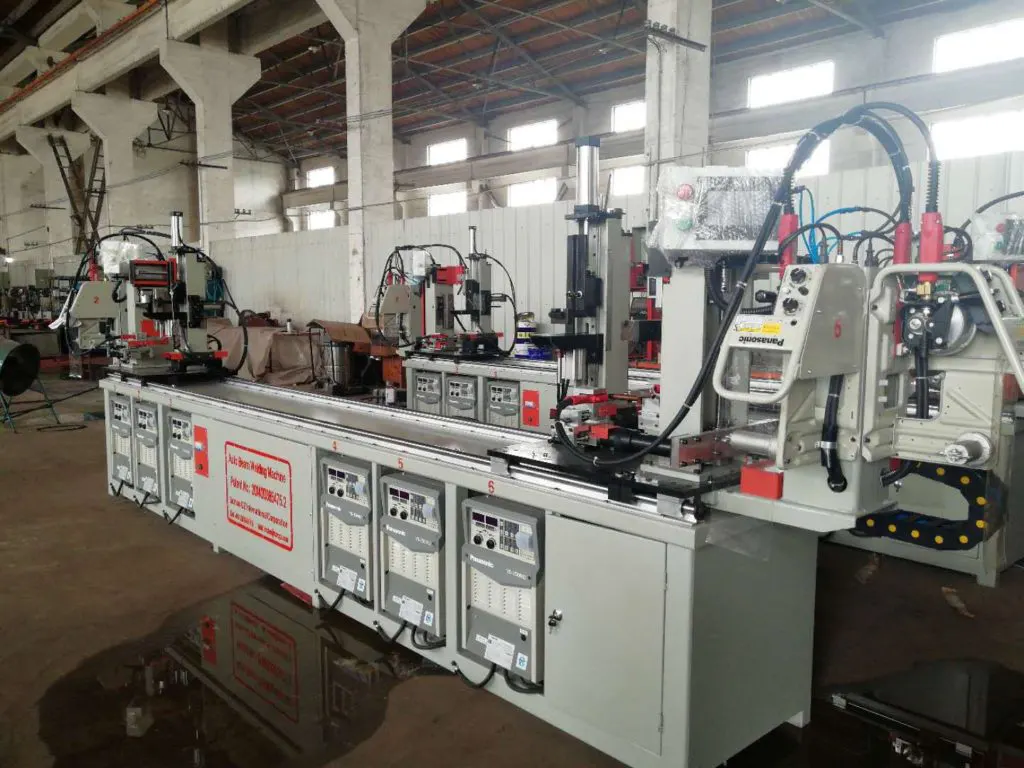
Rack Beam Welding Machine
The step a line does not cover: connector welding, 1200 – 4000 mm beams, 3 sides at once.
View machine
The other side
When a standalone machine is the better buy
A line is the default recommendation from every supplier, including us. It is not always the right one.
You already have a press and a decoiler
If the punching and coil handling exist and are not fully loaded, the line duplicates capital you have paid for. Buy the forming section and put the money into the part of the process that is actually the bottleneck.
The hall is too short
Forcing a line into a hall that does not fit it produces a bad layout, a short run-out and a decoiler nobody can load. A standalone former with an existing decoiler is the honest answer.
Volume is below one shift a week
An automatic line earns its control system by removing handling. Below one shift a week there is not enough handling to remove, and the extra sections never pay back.
Before you order
Questions this page usually raises
How long is a complete rack roll forming line?
It is the sum of its sections, and that sum is a quote item rather than a fixed figure: decoiler and coil car, leveler and feeder, punching, forming stands, cut-off and run-out, plus the space to load coil and remove bundles. Rather than quote a headline length, we lay the line out on your hall drawing, because the run-out and the coil access are usually what decide whether it fits.
Can a standalone machine be upgraded to a line later?
Yes, if the forming section is specified with that in mind at order — the entry and exit heights, the control system and the space for a punch station all have to allow it. Retrofitting a punch station into a former that was not designed for one is possible but costs more than specifying it at the start.
How many operators does a line need?
One operator for a line running coil to cut length, plus a helper on the run-out at volume. A standalone former with a separate press typically needs two or three people, because parts are handled between machines. That headcount difference is usually what pays for the extra sections.
Does the line include the welding of beam connectors?
No. Connector welding is a separate machine: a beam welding machine that welds the end connector onto a formed beam, handling beams 1200 – 4000 mm long and welding three sides of each end at once. A line produces the formed and cut beam; the welding station is quoted with it where the connector is welded rather than hooked.
Other selection guides
Selection guides
Head to head
Send the drawing and the output you need
The section drawing, the strip grade and the pieces per shift are enough to specify the machine — and enough to tell you if a different configuration would serve you better.