
Comparison · process choice
Roll Forming vs Press Brake for Racking Profiles
A press brake forms one bend at a time on a cut blank; a roll forming line forms the whole section from coil in a single pass. The choice is not about accuracy — a good press brake holds a bend angle as well as a roll former — it is about how many identical metres you need and how often the profile changes.
- Roll forming stations
- 13 – 30
- Strip thickness
- 0.4 – 3.0 mm
- Line speed
- 5 – 15 m/min
- Press brake
- bend by bend, blank by blank
The difference that matters is not accuracy
A press brake with a good operator holds a bend angle as accurately as a roll former, and on a short run it is in production before a roll set would have finished its first article. What a press brake cannot do is produce a section continuously from coil: every part is cut to blank, bent once for every bend in the section, and handled between operations.
So the question is not which process is better. It is which one fits the shape of your order book — one section in steady volume, or many sections in short runs. Everything else follows from that answer, including the labour you need and the tooling you have to own.
Where the arithmetic crosses over
A roll forming line has a fixed cost per profile: the roll design, the rolls themselves and the punch tooling. That cost is paid once and then spread over every metre formed on it. A press brake has almost no fixed cost per profile — a punch and a V-die cover a range of thicknesses and angles — and a higher cost per part, because every bend is a separate operation.
The crossover sits where the fixed cost per profile stops being the dominant number. In practice, on a single upright section, that is around 200 tonnes of strip a year: below it the line spends more time idle than forming, above it the cost per metre falls away from the press brake quickly.
Which process fits which order book
| Situation | Process that fits | Why |
|---|---|---|
| Prototype and first articles | Press brake | No roll design, no tooling lead time |
| Short runs of many sections | Press brake | Setup is minutes; a roll change is a shift |
| One profile family, steady volume | Roll forming | Forming cost per metre falls with length |
| Above roughly 200 t/yr on one section | Roll forming | Line stays loaded, one operator covers it |
| Thick strip at 3.0 mm | Either, carefully | Forming force and cut-off force both rise sharply |
The 200 t/yr figure is a planning rule of thumb for one upright section, not a technical limit of either process.
What a press brake costs in labour
A press brake needs an operator for as long as it is running, and the parts move between cutting, bending, punching and welding. A line needs one operator for the whole line, but it needs the volume to keep running. This is usually where the case is won or lost — not on the machine price, but on how many people are standing at how many machines per shift.
Where labour is cheap relative to capital, the press brake case is stronger for longer than the tonnage rule suggests. Where labour is the binding constraint, a line pays back in headcount rather than in speed, and the payback arrives faster than most buyers model.
Tooling: a roll set against a punch and die
Press brake tooling is general. Roll tooling is specific: a roll set is designed for one section, and the pass line and forming sequence are fixed by that section. This is the single clearest difference between the two processes, and it explains why a press brake shop can quote fifteen different brackets tomorrow and a roll forming line cannot.
It also explains the trap. A line bought for a section that is still being redesigned carries a tooling cost that has to be paid again for every revision. Freeze the section drawing before the roll design starts; that one discipline saves more than any negotiation on the machine price.
Where both are used in the same plant
Most racking plants end up with both, and that is not a compromise. End plates, connectors, base plates and brackets are press brake parts — small, varied and made in batches. The long sections are roll formed. The mistake is treating it as a single decision for the whole factory, when it is a decision per part family.
The useful question is not whether to buy a line or a brake, but which of your part families has enough repeat volume to amortise a roll set. Answer that per family and the investment order writes itself.
Machines for this job
The builds that cover it
Each of these is a standard build quoted against your drawing, not a catalogue item. Where none of them fits, the custom range starts from the same components.
-
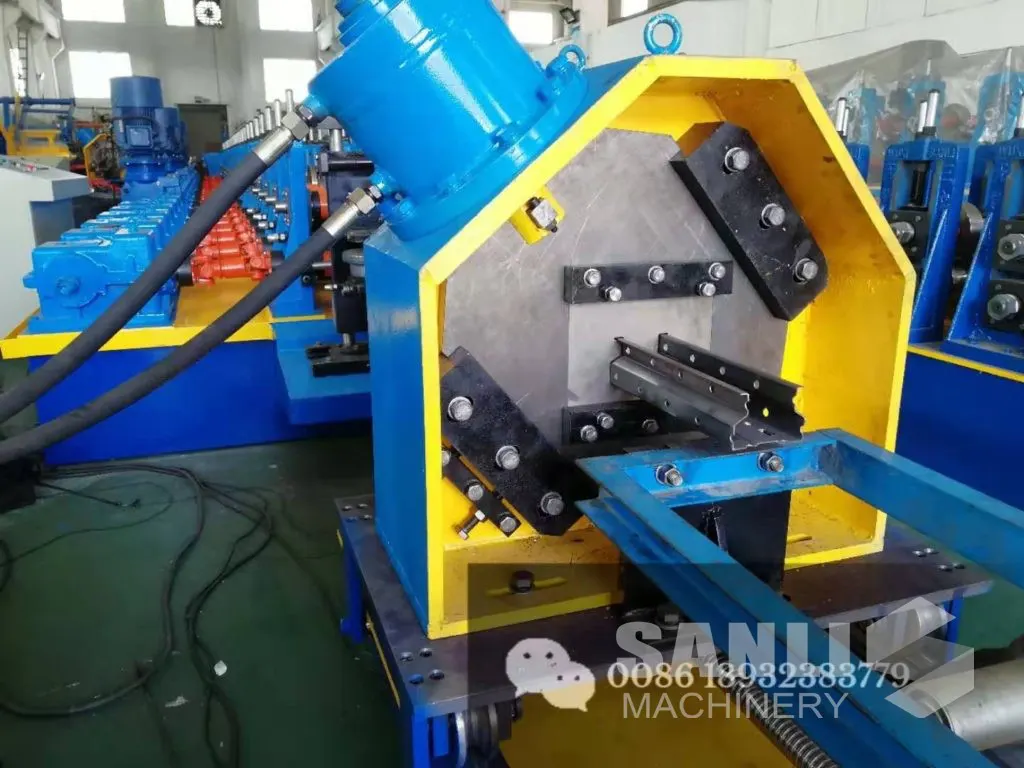
Rack Upright Roll Forming Machine
The section that justifies a line first: 1.5 – 3.0 mm, 18 stations, one operator.
View machine -
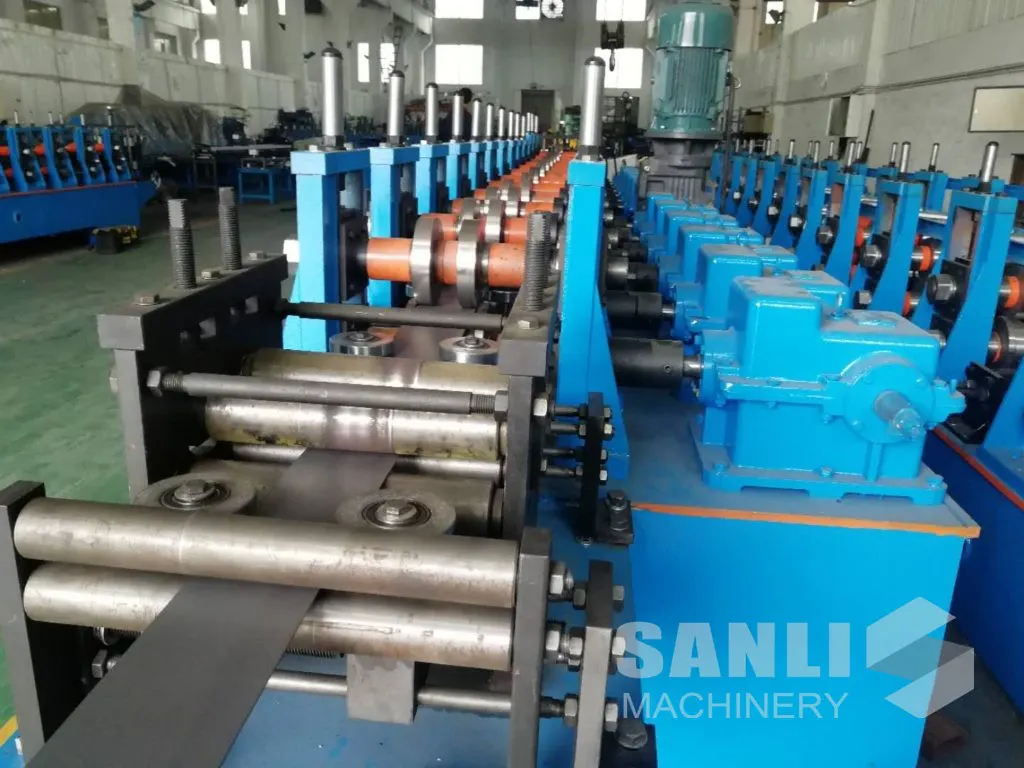
Rack Bracing Roll Forming Machine
The lowest-entry line: 1.4 – 1.8 mm through 13 stations, where part count sets the build.
View machine -
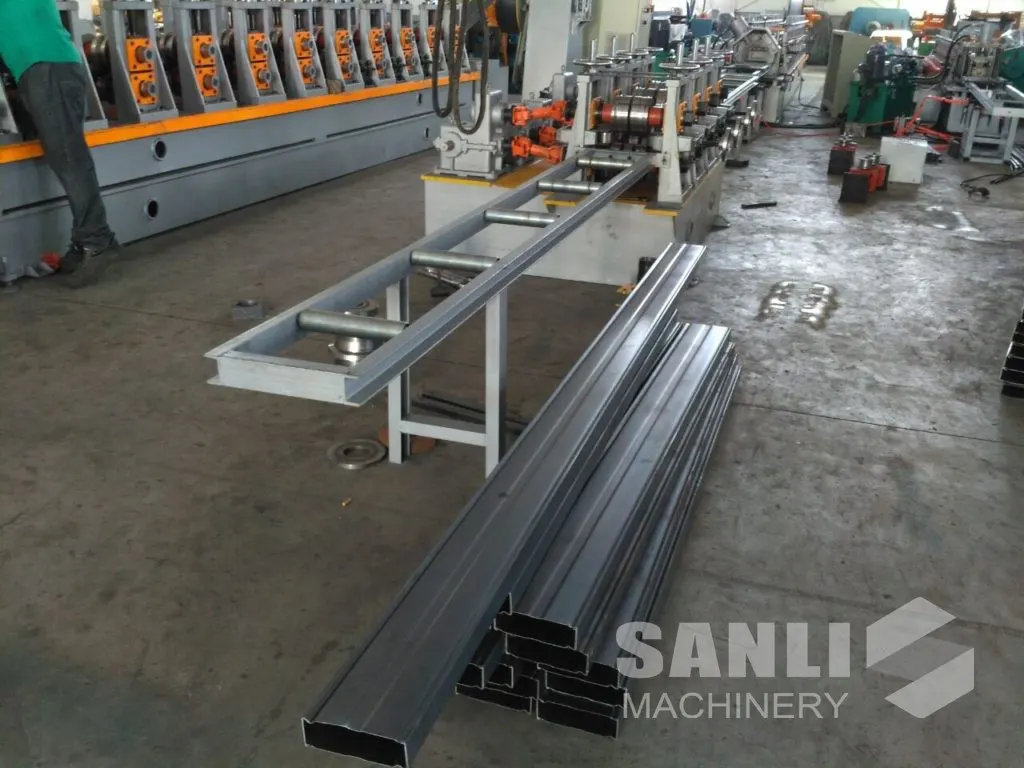
Rack Box Beam Roll Forming Machine
Where a press brake genuinely struggles: forming and closing a box section from coil.
View machine
The other side
When a press brake is the better answer
There are three situations where a line is the wrong investment, and they are common enough to say plainly.
Under roughly 200 t a year of one section
The line will be idle more than it forms. Bought profile, or a brake and a shear, returns the capital sooner and keeps the flexibility you already have.
Short runs of many sections
If each order is a different depth or a different hole layout, roll changes dominate the schedule and the machine becomes a liability rather than an asset.
The section drawing is not frozen
Roll design follows the drawing. Every revision after it starts is new tooling, not a change order. Wait until the section is stable, then tool up once.
Before you order
Questions this page usually raises
Can a press brake make a rack upright?
Yes, in the sense that a brake can bend every angle in an Omega section. What it cannot do is punch the tear-drop and butterfly holes in the same pass, or hold the hole pattern to the cut length, or run from coil. On a low volume the brake is viable. On steady volume the labour per upright is what makes it uncompetitive.
How long does a roll set change take?
It is a shift-level job, not a five-minute one: the stands are opened, the rolls are swapped, the pass line is reset and a first article is formed and measured before production resumes. That is the real reason a line suits one profile family — not that it cannot change, but that changing costs production time rather than tooling money.
Is roll forming more accurate than a press brake?
Not inherently. A roll former holds a section consistently along its full length, which a brake can struggle with on a long part, but a brake holds an individual bend angle at least as well. The honest difference is consistency over length and speed on repeat work, not peak accuracy.
What volume justifies a roll forming line?
Around 200 tonnes of strip a year on a single section is the working threshold — enough to keep the line loaded across a normal order cycle. Below it, the answer depends on how much of the cost is labour: if a line removes two operators per shift, fewer tonnes can still justify it.
Other selection guides
Selection guides
Head to head
Send the drawing and the output you need
The section drawing, the strip grade and the pieces per shift are enough to specify the machine — and enough to tell you if a different configuration would serve you better.