
Upright lines · AS/RS
Rack Upright Machines for Automated Warehouses
Uprights for automated storage and retrieval systems are judged on straightness, twist and hole position over the full column height, because a stacker crane works to a clearance measured in millimetres at 12 m and above. The machine that forms them is a heavy-duty upright line specified for accuracy, not simply for thicker strip.
- Strip
- 2.0 mm standard, up to 3.0 mm
- Forming stations
- 20
- Drive
- Gearbox, twin 22 kW
- Rolls
- Cr12, HRC 58 – 62
The specification that matters is tolerance, not tonnage
A selective racking column can be a few millimetres out and still assemble, because the beam connectors have clearance to absorb it. An AS/RS column cannot: the stacker crane runs inside a fixed envelope, and the tolerance budget for the whole aisle is shared between the floor, the base plates and the columns. Every millimetre of camber in the column comes out of the crane clearance.
That is why the AS/RS conversation starts with the acceptance drawing rather than with the strip thickness. Thickness sets the forming load; the acceptance drawing sets the roll set, the straightener, the cut-off and the inspection routine. A machine bought on tonnage alone will form the section and fail the inspection.
Selective racking compared with AS/RS columns
| Requirement | Selective racking | AS/RS |
|---|---|---|
| Column height | up to about 12 m | 12 – 24 m and above |
| Camber | absorbed by connector clearance | shared with crane clearance; agreed at order |
| Hole position | functional, checked per batch | functional and inspected per column |
| Drive | chain or gearbox | gearbox, for repeatability over long runs |
| Roll material | GCr15 on light builds | Cr12, HRC 58 – 62 |
| Inspection | first article | first article plus in-process sampling |
The machine can be the same family as a heavy-duty upright line. What changes is the accuracy class it is set up and inspected to.
What the machine needs to hold the tolerance
Straightness comes from three places on the line: the straightener before forming, the alignment of the roll stands, and the cut-off. A worn or badly set straightener puts a curve into the strip that the forming stands cannot take out. Stand alignment that drifts produces a section that is right at the entry and wrong at the exit. A cut-off that is not square to the line reads as a bend during assembly even when the column is straight.
The heavy-duty build addresses this with a gearbox drive on Ø80 mm shafts, Cr12 rolls at HRC 58 – 62, an Omron encoder for length and a Delta control system — not because those parts are faster, but because they hold their setting over a long run. On AS/RS work the repeatability of the tenth thousand column matters as much as the accuracy of the first.
- Straightener condition checked before the run, not after the first reject.
- Stand alignment recorded at commissioning so it can be re-checked, not re-guessed.
- Encoder and cut length verified against a measured sample, not the display.
- Sample columns measured at the top and the bottom of the length.
Hole patterns for automated systems
AS/RS uprights commonly carry a denser hole pattern than selective racking, because the beam levels are set by the system design rather than by a catalogue. That changes the punch tooling more than the forming line: more holes per metre means more punch strokes, which moves the punch from being one station in the chain to being the cycle.
The punch moulds are SKD11 with an inserted lower die and cover 1.5 – 3.5 mm, made to the hole layout on your drawing. If the pattern has more than one hole shape on the same pitch, say so early — the tooling arrangement and the press tonnage both change, and it is cheaper to design it once.
Machines for this job
The builds that cover it
Each of these is a standard build quoted against your drawing, not a catalogue item. Where none of them fits, the custom range starts from the same components.
-
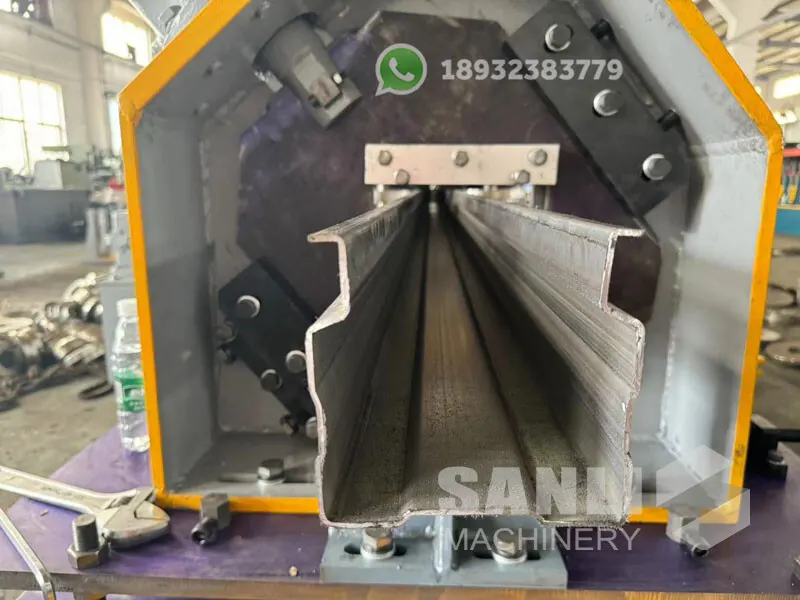
Heavy Duty Rack Upright Roll Forming Machine
The build this work needs: 20 stations, twin 22 kW, gearbox drive, Cr12 rolls, 2.0–3.0 mm.
View machine -
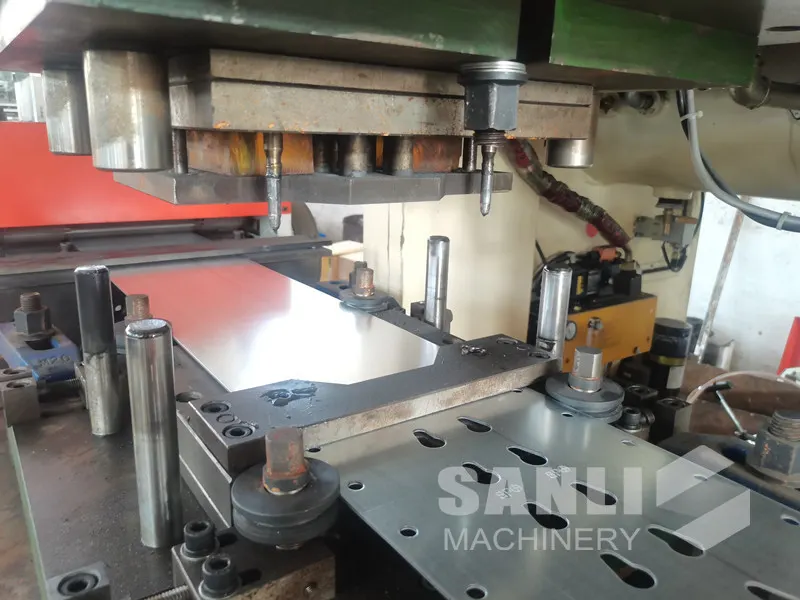
Punch Mould for Rack Upright
Dense hole patterns tooled to drawing, SKD11, 1.5–3.5 mm, on-line or as a standalone press tool.
View machine
The other side
When an AS/RS specification is over-buying
Accuracy costs money in tooling, inspection and setup time. It is worth it only where the tolerance is actually consumed.
The columns are for selective racking
A selective rack absorbs camber in the connector clearance. Paying for an AS/RS accuracy class on selective work buys inspection hours nobody needs.
The floor is the tolerance problem
If the aisle floor is not flat to the figure the system designer assumed, no column accuracy saves the installation. Fix the slab before specifying the machine.
One AS/RS project in five years
Tooling and setup for a single project land entirely on that project. If AS/RS is occasional, forming those columns at a specialist and concentrating on your volume parts is usually the better trade.
Before you order
Questions this page usually raises
What straightness can the machine hold?
It depends on the section and on the acceptance figure agreed at order, so we do not quote a blanket number. What we do is agree the figure in writing before the roll set is designed, inspect to it at first article, and record the result. If your customer specifies straightness, send that figure with the enquiry — it changes the straightener and the roll set, and discovering it after the machine is built is expensive for both sides.
Does AS/RS work need a different machine from heavy-duty racking?
Usually the same machine family — a heavy-duty upright line with twin 22 kW motors, Ø80 mm shafts and Cr12 rolls. What differs is the accuracy class it is set up and inspected to, and often the hole pattern. That is a specification and inspection difference rather than a different machine.
Which drive is better for repeatability?
A gearbox drive, which is what the heavy-duty build uses. It holds its setting over a long run and keeps the load distributed across the stand train, where a chain drive is the part that wears and drifts first. On AS/RS work that drift shows up as a section that changes over a shift.
Can the line punch both the beam holes and the upright holes?
The upright line punches the upright pattern. Beam holes are punched on the beam line, because the strip width, the punch arrangement and the forming direction are different. Trying to cover both patterns on one line means changing tooling and guides between parts, which is exactly what AS/RS volume does not allow.
Other selection guides
Selection guides
Head to head
Send the drawing and the output you need
The section drawing, the strip grade and the pieces per shift are enough to specify the machine — and enough to tell you if a different configuration would serve you better.