
Comparison · two different parts
Rack Upright vs Beam Roll Forming Machine
A rack upright machine forms the Omega-section column that carries the load; a beam machine forms the horizontal member that locks into it. They are not two sizes of the same machine: the upright is an open section punched before forming, the beam is a closed or stepped section where the difficulty is at the strip edge, so station count, motor power and cut-off type all differ.
- Upright build
- 18 – 20 stations
- Upright motor
- 15 kW – 22 kW × 2
- Beam build
- 14 – 23 stations
- Beam motor
- 22 – 30 kW
The part decides the machine
An upright is an open section. The strip enters as a flat coil and leaves as a column: a face, two returns and two lips that read as an Omega from above. Nothing is closed, and nothing has to be. The forming work happens across the width of the strip, and the section holds its shape because the bends are shallow and the returns do the stiffening.
A beam is the opposite geometry. A box beam is formed from the strip edge until the two edges meet and the seam is closed; a step beam folds a flange back on itself through two planes so that decking sits on it. In both cases the forming problem sits at the edge of the strip rather than at the face, and the last stands do work that an upright line never asks for.
What the two machine families actually differ in
| Aspect | Upright | Box beam | Step beam |
|---|---|---|---|
| Strip thickness | 1.5 – 3.0 mm | 1.5 – 2.0 mm | 1.2 – 1.6 mm |
| Forming stations | 18 – 20 | 14 – 16 | 23 |
| Main motor | 15 kW, or 22 kW × 2 | 22 kW | 30 kW |
| Section | Open Omega, no seam | Closed box, seam shut | Stepped flange, two planes |
| Cut-off | Hydraulic stop cut | Hydraulic stop cut | Flying saw |
| What limits accuracy | Twist and hole position | Seam gap at the closure | Flange angle and saw burr |
Station counts and motor ratings are the builds we quote most often, taken from the machines listed below — not the limits of what can be built.
The upright: holes before forming
Every upright is punched, and the punch station sits before the forming stands. The strip is punched flat, then formed, then cut. That order is what allows the hole pattern to be held to the same datum as the cut length: the line knows where the strip is, so it knows where the holes are relative to the end that has not been cut yet.
It also means the upright line is specified around the hole pattern as much as around the section. Two uprights with the same profile and different hole layouts need different tooling, and a layout with an extra row of holes can need an extra punch station. That is a bigger difference between two quotes than most buyers expect when both are described as an upright machine.
The forming passes stretch the pattern slightly, and the stretch is a property of the section rather than of the machine. The tooling is set to compensate, and the check is the same on every line: measure the pitch on the flat strip before forming, measure it again on the finished column, and sign the first article.
The beam: a seam that has to close
A box beam starts as flat strip and ends as a tube. The last two or three stands do the closing, and the roll gap there is set so the seam shuts without crushing the corner radius. Set it tight and the corner thins; set it loose and the seam springs open after the cut. That is why a 1.5 mm box beam takes 14 stations and a 2.0 mm automatic build takes 16, while the same thickness in an upright takes 18 to 20: the stations are doing different work.
A step beam is a different problem again. The flange folds through two planes at 1.2 – 1.6 mm, which needs 23 stations and a 30 kW main motor, and because the flange is thin and the section is deep, the cut is normally made with a flying saw rather than a stop cut. A stop cut on a deep thin flange distorts the edge, and the distortion shows up as a step that does not seat.
Which one to buy first
Most racking plants start with the upright, for two reasons that have nothing to do with price. It is the part with the longest setup, and it is the part a subcontractor is least likely to hold to your exact hole layout — a supplier forming your uprights on their own pattern gives you a column that assembles with their beams and not necessarily with yours.
The beam follows when volume justifies it, which in practice means when beam supply is the thing delaying deliveries. If that is already the case, the order reverses and there is nothing wrong with starting with the beam. What does not work is buying a beam machine in the expectation that it will also make uprights.
Can one machine form both
No, and the reason is the roll set rather than the frame. A roll set is designed for one section: the pass line, the number of bends and the sequence in which they are formed are all fixed by the profile. An upright roll set cannot be re-sequenced into a box beam, because the box beam needs its closure at the end and the upright has no closure to give it.
What is shared between the two machines is the coil handling, the control platform and the hydraulics. That is why a plant buying both usually buys them as two lines with the same control system and the same electrical spec — one spare-parts shelf, one operator skill set, two machines that cannot be swapped.
Machines for this job
The builds that cover it
Each of these is a standard build quoted against your drawing, not a catalogue item. Where none of them fits, the custom range starts from the same components.
-
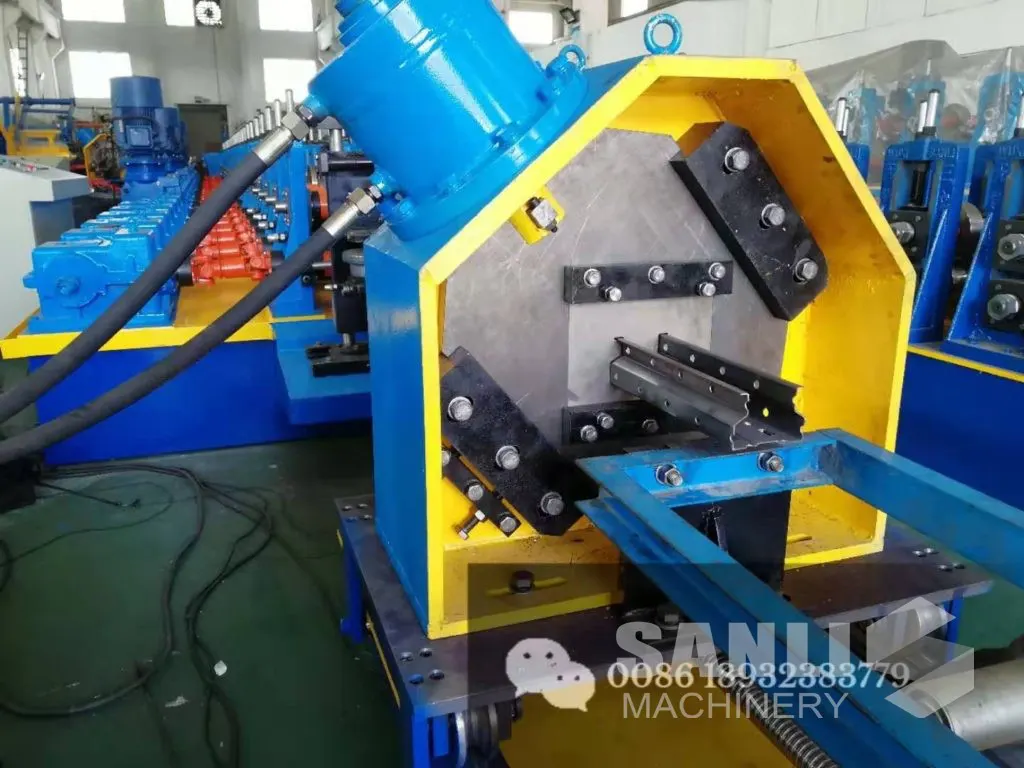
Rack Upright Roll Forming Machine
The upright side of the comparison: 1.5 – 3.0 mm, 18 stations, 15 kW, holes punched on line.
View machine -
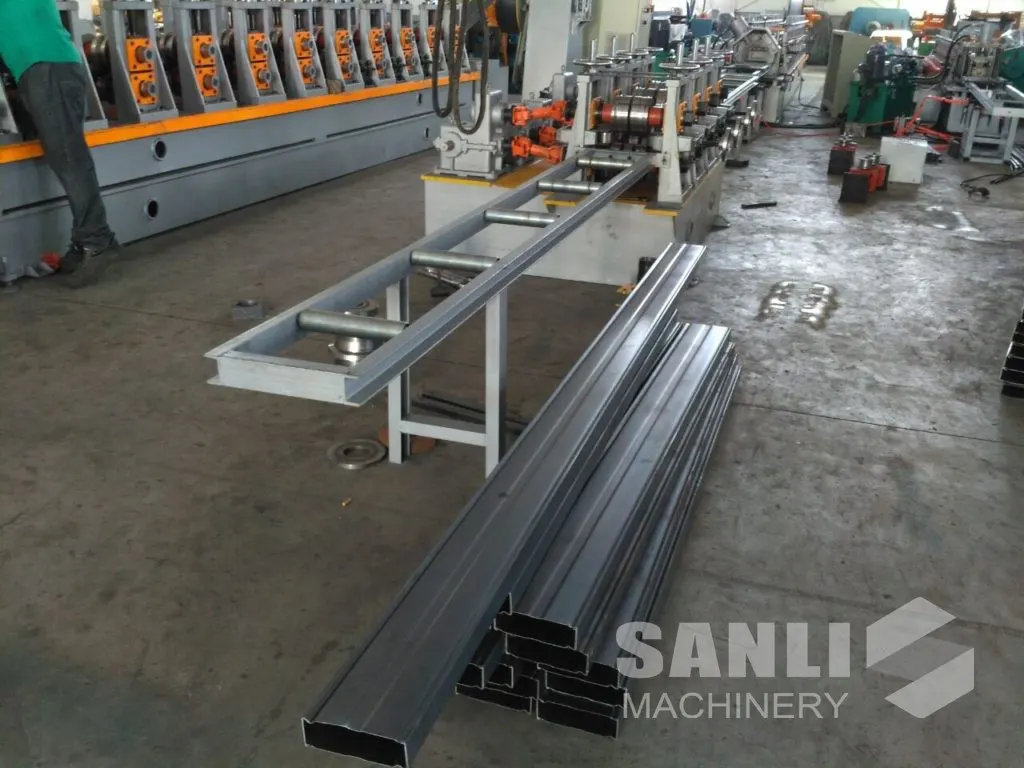
Rack Box Beam Roll Forming Machine
The box beam side: 1.5 – 1.8 mm through 14 stations at 22 kW, seam closed after forming.
View machine -
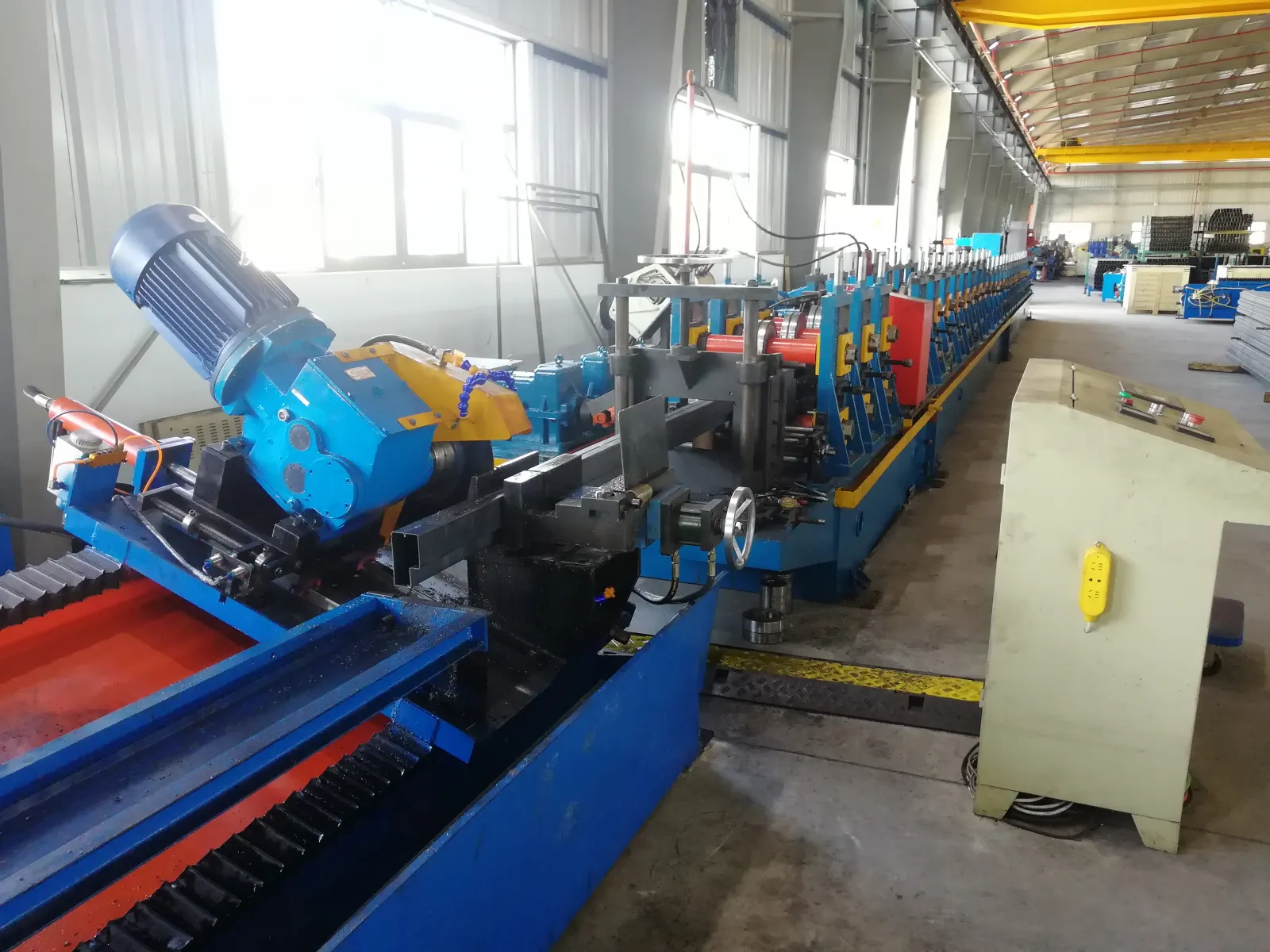
Pallet Rack Step Beam Roll Forming Machine
The step beam side: 1.2 – 1.6 mm, 23 stations, 30 kW, flying saw for the thin deep flange.
View machine
The other side
When neither is the next purchase
Both machines make a part. If the part is not the constraint, neither is the answer.
Forming is not your bottleneck
If uprights arrive on time and the queue is in welding or coating, a forming line adds capacity in front of a bottleneck and inventory behind it. Fix the queue first.
You are still buying the part cheaper than you can form it
Under roughly 200 t of strip a year on a single section, a line spends more time idle than forming. Bought profile plus fabrication usually returns the capital faster.
You want one machine to cover both parts
It does not exist, and a supplier who says it does is describing a machine with two roll sets and a changeover nobody has costed. Two machines, or one machine and bought profile, are the honest options.
Before you order
Questions this page usually raises
Which costs more, an upright machine or a beam machine?
They are driven by different things, which is why comparing them on price alone tells you very little. The upright line carries 18 – 20 stations plus punch tooling; the box beam line carries fewer stations but has to close a seam; the step beam line carries 23 stations, a 30 kW main motor and a flying saw. Ask each quote for its thickness range, station count and cut-off type in writing, and the difference stops being a mystery.
Do uprights and beams use the same strip?
No. Uprights run 1.5 – 3.0 mm, box beams 1.5 – 2.0 mm and step beams 1.2 – 1.6 mm in the builds we quote most often. The coil width differs as well, because the developed width of the section differs. Two lines in the same plant usually mean two coil specifications, and that is worth knowing before the decoiler is specified.
Can a beam machine also form bracing?
No. Bracing is a third section family: 1.4 – 1.8 mm through 13 stations, and the part count per frame rather than the section complexity is what sets the build. It is the cheapest line of the three, which is why it is often the second machine a plant buys after the upright.
Which part should a new plant form first?
The upright. It has the longest setup, the tightest functional tolerances and the hole pattern that ties your frames to your connectors. Forming the upright in house means the pattern is yours. Beams can be bought for longer without a quality penalty, because a beam is a commodity section in a way an upright with your hole layout is not.
Other selection guides
Selection guides
Head to head
Send the drawing and the output you need
The section drawing, the strip grade and the pieces per shift are enough to specify the machine — and enough to tell you if a different configuration would serve you better.