
Upright lines · output
High-Speed Rack Upright Lines: What Sets the Rate
Line speed on a rack upright machine is set by the slowest station in the chain, not by the forming section. The bottleneck is normally the punch, then the cut-off, then the coil change. Our standard upright builds run 5 – 15 m/min; anything faster is a different specification with a different cut-off, and should be quoted as one.
- Standard build
- 5 – 15 m/min
- Forming stations
- 18 – 20
- The usual bottleneck
- Punch cycle
- Step change at
- Flying cut
Find the constraint before buying speed
A roll forming line is a chain: decoiler, leveler, servo feed, punch, forming stands, cut-off, run-out. Strip moves through it at the speed of the slowest link. On an upright line that is usually the punch, because the press has to complete a full stroke and clear the slug while the strip is stationary, and the forming stands then have to be able to run faster than that cycle to be worth anything.
This is why two machines quoting the same 15 m/min can produce different numbers. The forming section may be identical; the punch tooling, the feed acceleration and the cut-off are not. Ask for the cycle time of the punch and the cut-off, not only the line speed.
What each speed band actually requires
| Line speed | Cut-off | Feed | What it buys |
|---|---|---|---|
| 5 – 10 m/min | Stop cut, hydraulic | Standard servo feed | Heavy gauge work; the punch dominates anyway |
| 10 – 15 m/min | Stop cut, faster return | Servo feed with loop control | The standard upright build; realistic for 2 – 3 mm |
| 20 m/min and up | Flying cut or flying shear | Loop accumulator, high-acceleration feed | Thin to medium gauge only; line length grows |
A stop-cut line stops the strip for every cut, so it loses one cut length per cycle. That penalty is small at 10 m/min and decisive at 25.
Why the cut-off is the step change
Up to about 15 m/min a stop cut is fine: the strip stops, the blade comes down, the strip restarts, and the lost time is a fraction of the cycle. Above that the stop becomes the cycle. The answer is a flying cut, where the cut-off travels with the strip and cuts on the move — and once you need a flying cut you also need an accumulator loop so the strip can keep moving while the cut happens, and a run-out that can take parts at that rate.
That is the honest structure of a high-speed line: the forming section barely changes, and the cut-off, the loop and the run-out all change at once. It is also where most of the extra capital sits.
- Cut-off type and cut cycle time, in seconds.
- Accumulator or loop capacity, in metres of strip.
- Feed acceleration, not just top feed speed.
- Run-out or stacker rated for the same rate as the line.
- Coil change time — at 20 m/min a coil lasts hours, not shifts.
When speed does not pay
Speed pays when the line runs one section for long stretches. It does not pay when the schedule is a mix of widths and hole patterns, because the time lost is in the changeover and no amount of line speed recovers it. On an upright line a pattern change means a punch tooling change, and that is measured in hours.
Before specifying a faster line, measure what your current line actually loses. If the answer is coil changes and pattern changes, the money is better spent on a second roll set, a quick-release punch cassette, or a coil car — all of which shorten the stop rather than shorten the cycle.
Machines for this job
The builds that cover it
Each of these is a standard build quoted against your drawing, not a catalogue item. Where none of them fits, the custom range starts from the same components.
-
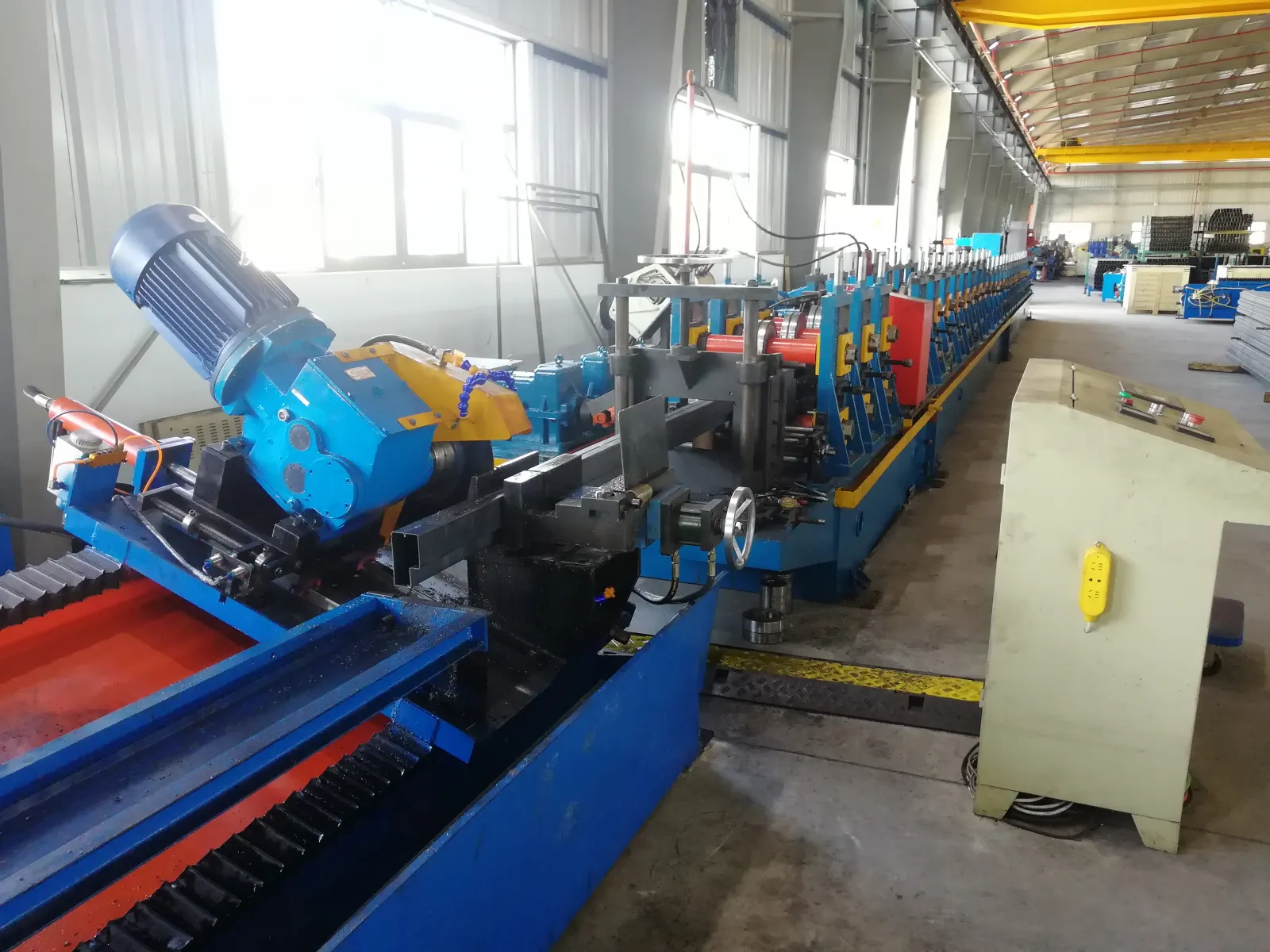
Pallet Rack Step Beam Roll Forming Machine
Fly saw cut on a 23-station, 30 kW line — the cut-off arrangement high speed depends on.
View machine -
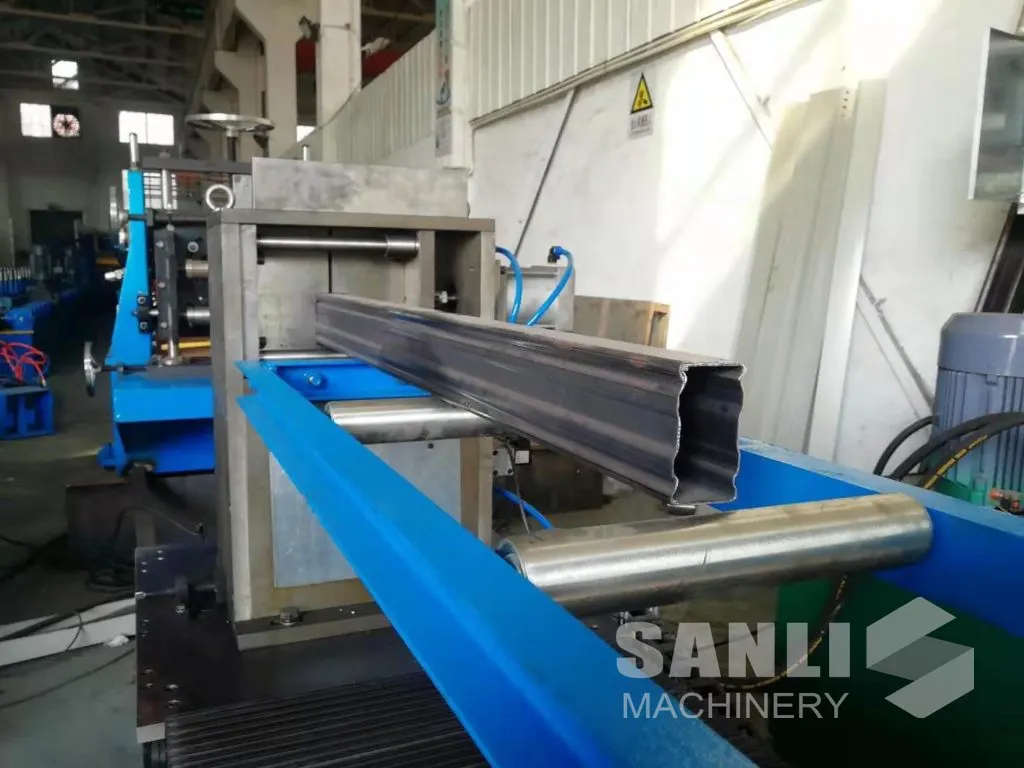
Rack Self-Locked Beam Roll Forming Machine
28 stations and a 37 kW motor: where station count rather than speed sets the cycle.
View machine -
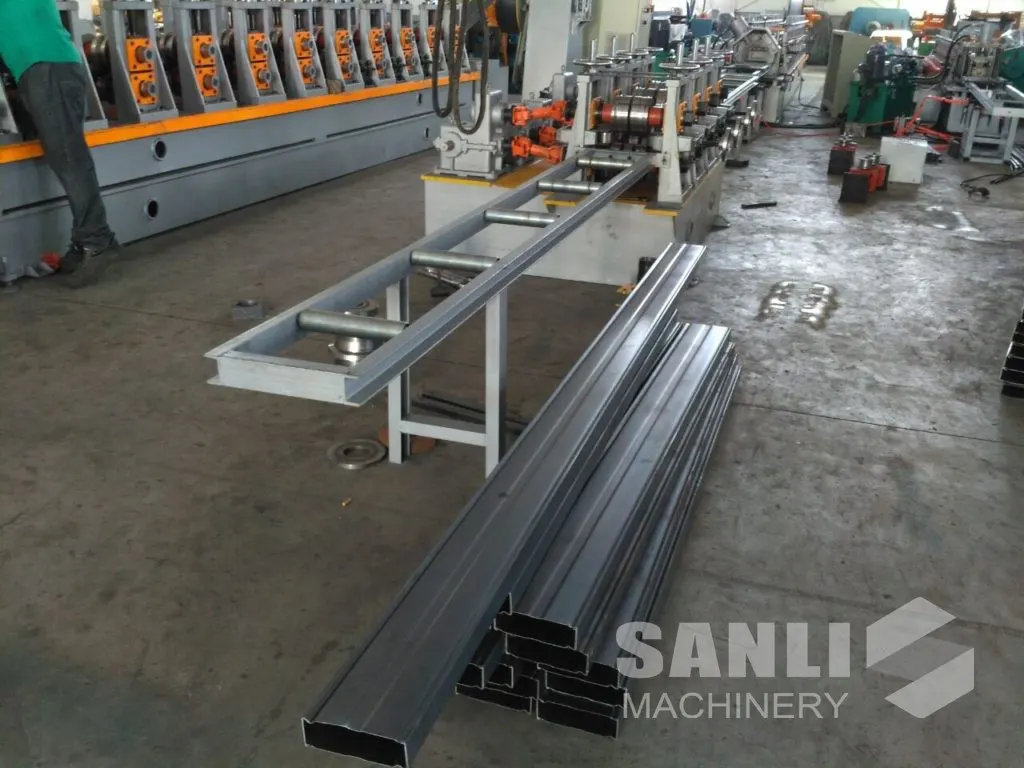
Rack Box Beam Roll Forming Machine
The volume case done simply: 14 stations, 22 kW, up to 15 m/min with a stop cut.
View machine
The other side
When a faster line is the wrong answer
Speed is the most over-bought specification on a rack forming line. Three cases where it will not return the money.
More than one changeover a shift
If the line stops for a pattern or section change every few hours, the changeover is the constraint. Fix the changeover first; the speed becomes irrelevant.
You are feeding a powder coating line
A forming line that outruns the coating line produces work in progress, not throughput. Match the two rates before buying speed on either.
The strip is 3.0 mm
Heavy gauge forming and high speed pull against each other: the load that makes 3.0 mm work is the load that limits the rate. Expect the lower half of the speed range, and buy accuracy instead.
Before you order
Questions this page usually raises
Can your upright line run 25 m/min?
Our standard upright builds are quoted at 5 – 15 m/min. A 25 m/min target is a different specification: it needs a flying cut-off, an accumulator loop, a high-acceleration feed and a run-out sized to match, and it is normally only sensible below about 2 mm strip. We would quote that as a separate machine rather than describe a standard line as capable of it.
What is the actual output of a 15 m/min upright line?
At 15 m/min with 3.0 m finished length the arithmetic gives 300 pieces an hour. After coil changes, pattern changes and cut-off stops, plan on around 200. The gap between the two numbers is where most investment decisions go wrong, because quotes are written against the first and production runs at the second.
Does a servo feed improve accuracy or speed?
Both, but the accuracy gain matters more. A servo feed holds cut length to a repeatable figure and accelerates faster than a mechanical feed, which shortens the stop for each cut. On a stop-cut line that is where a few percent of cycle time comes from.
Is a flying cut available on heavy gauge?
It exists but it is rarely the right choice. Flying cut-off is most useful where the strip is light enough to accelerate quickly and the section is simple. At 3.0 mm the mass and the cut force work against it, and a well-set stop cut is the more reliable arrangement.
Other selection guides
Selection guides
Head to head
Send the drawing and the output you need
The section drawing, the strip grade and the pieces per shift are enough to specify the machine — and enough to tell you if a different configuration would serve you better.