
Definition
What Is a Rack Roll Forming Machine?
A rack roll forming machine is a production line that turns steel coil into a racking component — an upright column, a beam, a bracing bar or a shelf panel — by pulling the strip through a series of driven roll stands that bend it progressively into the finished section, punching the holes while the strip is still flat and cutting it to length after the last stand.
- Strip thickness
- 0.4 – 3.0 mm
- Forming stations
- 10 – 30
- Line speed
- 5 – 15 m/min
- Floor space
- 28 – 32 m × 4 – 5 m
It makes one part, continuously, from coil
The distinction that matters is not "machine versus manual" but "continuous versus batch". A press brake makes a part by holding a blank and bending it one edge at a time; a roll forming line takes coil off a mandrel and never stops holding the part until it is cut. That is why the output is measured in metres per minute rather than in pieces per hour, and why the cost per part falls steeply with volume while the setup cost stays fixed.
A rack plant buys one line per component because the roll set is cut to one section. An upright line cannot form a beam, and a beam line set for 1.8 mm will not run a 0.6 mm shelf panel without a different set of rolls. The machine is therefore specified around the part, not around the plant.
Three ways to get a rack component, and what each costs you
| Roll forming line | Press brake | Bought-in part | |
|---|---|---|---|
| Cost per part at volume | Lowest | High — one bend at a time | Supplier margin included |
| Section consistency | Held by the rolls | Depends on the operator | Held by the supplier |
| Changing section | New roll set | New tooling, cheaper | New supplier conversation |
| Best when | One section, high volume | Short runs, prototypes | Volume too low to justify a line |
Most rack plants run a roll forming line for the main components and keep a press brake for the parts that never justify tooling.
The six stations every line has
Configurations differ, but the sequence does not. Reading a quotation means reading these six items.
- Decoiler — holds the coil and feeds strip at a controlled tension. Manual on light gauges, hydraulic with a coil car once the coil is too heavy to lift by hand.
- Leveller — removes coil set before forming. Skipping it is the most common reason a finished section arrives bowed.
- Punching station — makes the holes while the strip is flat. Punching flat stock holds hole position to the strip edge; punching after forming references it to a folded face instead.
- Forming stands — the roll stands that bend the strip progressively. Station count follows the number of bends and the roll pitch the gauge needs, not the thickness alone.
- Cut-off — hydraulic stop-and-cut, or a flying saw that cuts on the move. The choice is a throughput decision, not a quality one.
- Run-out — an out table or stacker. On most lines this is what actually sets the achievable cycle, because it is where parts stop being continuous.
What the line does not do
A roll forming line forms and punches. It does not weld the connector onto a beam, it does not powder coat, and it does not assemble the frame — those are separate stations, and a quotation that does not mention them is not quoting a complete part. On a box beam the seam may be closed by the rolls or welded after them; on a beam the end connector is fitted on a welding machine.
It also does not change section by itself. Length, hole pitch within the tooling and batch count are recipe values; the section is cut into the rolls. That single fact is what decides whether a second product range means a second line or a second roll set.
What decides the specification
Four inputs fix almost the whole quotation: the section drawing decides the roll set and station count, the strip thickness decides motor power and frame rigidity, the hole pattern decides whether the punch is hydraulic or servo, and the required output decides how much of the coil-to-pallet sequence is automated. Everything else — voltage, colour, documentation — is an option on top of those four.
Machines for this job
The builds that cover it
Each of these is a standard build quoted against your drawing, not a catalogue item. Where none of them fits, the custom range starts from the same components.
-
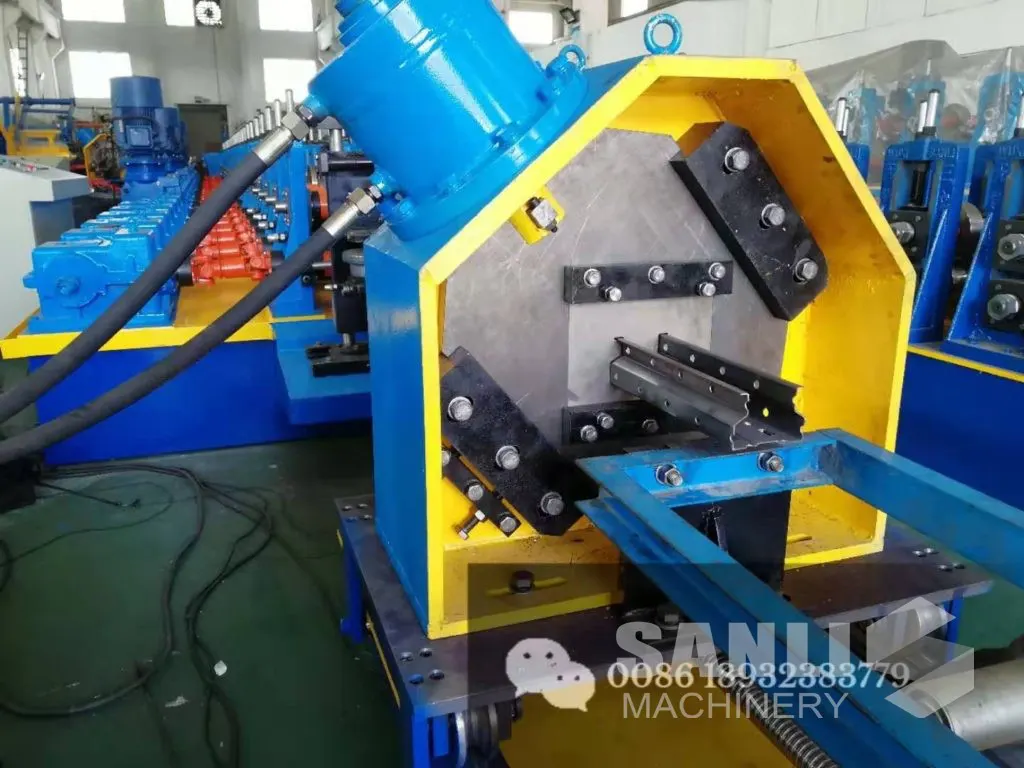
Rack Upright Roll Forming Machine
The machine most plants start with: 18 stations, 1.5 – 3.0 mm, holes punched before forming.
View machine -
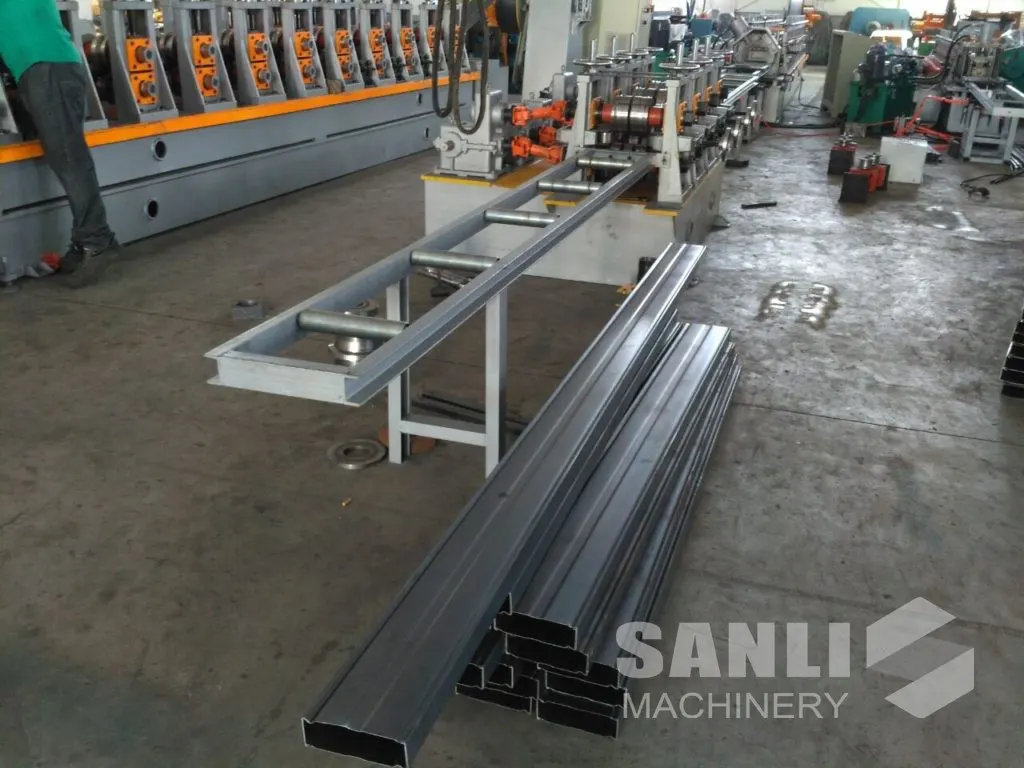
Rack Box Beam Roll Forming Machine
The closed section, where the difficulty moves from the hole pattern to closing the seam.
View machine -
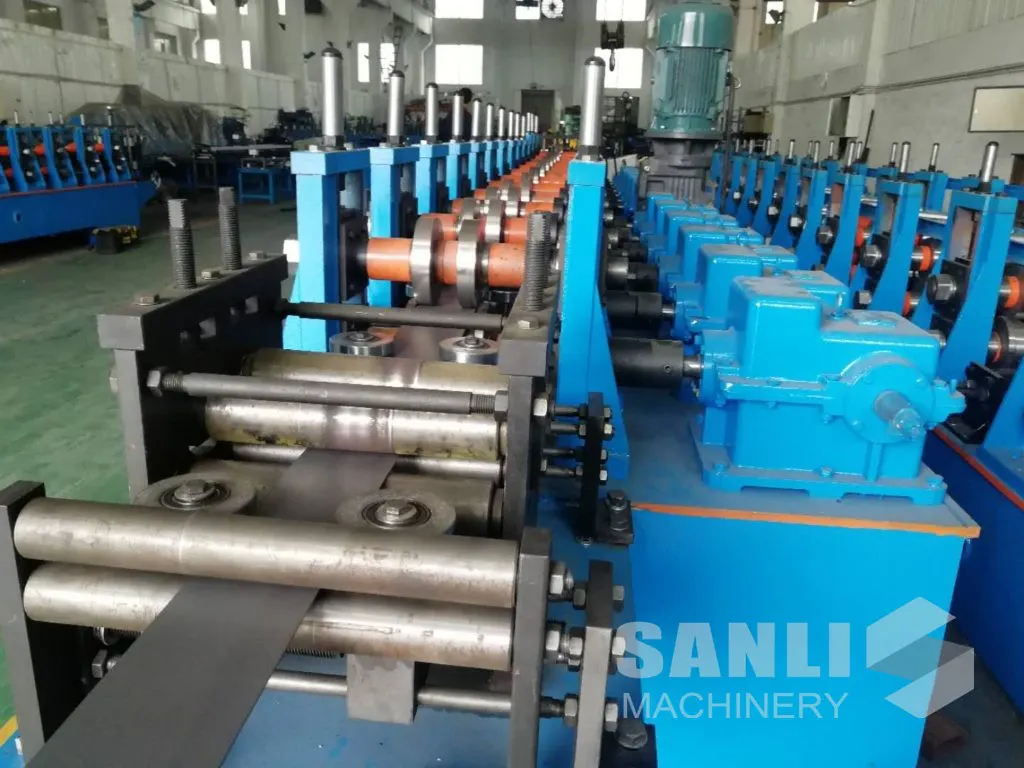
Rack Bracing Roll Forming Machine
The highest-volume part in a frame, and the line that decides whether the plant keeps up.
View machine
The other side
When a roll forming line is the wrong answer
A line is worth its price only when one section repeats. These are the cases where it does not.
You buy the part cheaper than you can make it
For a plant under roughly a hundred frames a month, a bought-in upright often costs less than the depreciation, floor space and operator time of a line. The line starts to win when the queue in front of a subcontractor starts costing deliveries rather than money.
Every order is a different section
Custom racking with a new section on every project means a new roll set on every project. At that point the line is being used as a press brake, and a press brake is cheaper.
You need the part next month
Rolls and punch tooling are made after the section drawing is approved, which is why lead times run 50 to 80 days before shipping. If the part is needed sooner, buying it in is the only route that meets the date.
Before you order
Questions this page usually raises
What is the difference between a roll forming machine and a roll former?
Nothing structural — "roll former" is the shorter name for the same machine, and the terms are used interchangeably in the racking industry. A "line" usually implies the full sequence: decoiler, leveller, punch, forming stands, cut-off and run-out, rather than a standalone forming machine fed with pre-cut blanks.
How much floor space does a rack roll forming line need?
A complete upright line runs about 28 to 32 m long and 4 to 5 m wide, including the run-out table and the hydraulic station. A bracing or shelf stiffener line is shorter because the parts are shorter. The run-out is usually the item that decides the layout, so agree its length with the column range rather than with the building.
How many people does it take to run one line?
One operator plus one helper is the normal arrangement: the operator runs the control and checks the first article, the helper handles coil changes and takes parts off the run-out. A fully automatic box beam line is specified so that one operator can run it without anyone at the entry or exit.
Does a rack roll forming machine include the tooling?
The roll set for the section in the order is included — that is the tooling the machine is built around. A second section needs a second roll set, and a different hole pattern needs different punch tooling. Both are quoted at order stage because making them later means the line has to be recommissioned.
Other selection guides
Selection guides
Head to head
Send the drawing and the output you need
The section drawing, the strip grade and the pieces per shift are enough to specify the machine — and enough to tell you if a different configuration would serve you better.