
Applications · cold store
Roll Forming Machines for Cold Storage Racking
Cold store racking is almost always galvanised rather than painted, because paint blisters where a freezer cycles through thaw and condensation. That decision is made before the machine is specified: it changes the strip surface the rolls see, the roll finish, and whether the galvanising happens before or after forming.
- Typical coating
- Pre-galvanised or hot-dip
- Strip
- 1.4 – 2.5 mm
- Service temperature
- −25 °C and below
- Roll finish
- Polished, no marking
The coating decides more than the machine
There are two ways to get a galvanised rack out of a roll forming line. The first is pre-galvanised coil: the strip arrives with its zinc coating, is formed and punched, and the cut edges and the holes are the only bare steel. The second is to form black steel and hot-dip galvanise the finished parts.
Pre-galvanised is cheaper per tonne and needs no second process, but the coating is soft and every roll that touches it leaves a mark. Hot-dip gives a heavier, more uniform coating and covers the cut edges, but it happens after forming, so the holes have to be sized for the zinc that will fill them and the parts have to be handled again. Which one you use decides what the machine has to be good at.
Cold store coating routes and what each asks of the line
| Route | What the line must do | Watch for |
|---|---|---|
| Pre-galvanised coil | Polished rolls, generous radii, controlled roll gap | Roll marks and galling on the zinc surface |
| Hot-dip after forming | Clean cut, correct hole size, drain points | Zinc bridging small holes; distortion in the dip |
| Powder coated (ambient only) | Standard build, no special roll finish | Coating fails at freezer temperatures |
The machine can be the same build in all three cases. What changes is the roll finish, the roll gap setting and the cut quality.
Why paint fails in a freezer
A cold store cycles: the door opens, warm moist air enters, condenses on cold steel, and freezes. Paint films are not fully impermeable, and moisture that reaches the steel underneath lifts the film from the inside. Once a blister opens, the corrosion runs under the paint and the repair is a shutdown, not a touch-up.
That is why galvanising is the default for freezer racking, and why a plant that already supplies cold store customers usually already knows which route it uses. If you are quoting for a cold store project, that answer comes from the end customer specification, not from the machine builder.
- Confirm the coating route before the roll set is designed — it changes roll finish and gap.
- On pre-galvanised strip, ask for polished rolls and no sharp radii at the section corners.
- On hot-dip, confirm hole sizes allow for zinc thickness, and that drain points exist.
- Check the steel grade impact requirement at the service temperature with the structural engineer.
Where the machine is the same
Bracing, shelf panels and beams for a cold store are formed on the same machines as ambient racking: 13 stations for bracing at 1.4 – 1.8 mm, 30 stations for shelf panels at 0.4 – 1.2 mm, 14 stations for box beam at 1.5 – 1.8 mm. The difference is the strip surface and the roll finish, not the line layout.
The upright is the part where cold store projects change the specification most often, because freezer racking tends to run taller than ambient selective racking and the column straightness starts to matter. That pushes the upright line towards the heavy-duty build even where the strip is only 2.0 mm.
Machines for this job
The builds that cover it
Each of these is a standard build quoted against your drawing, not a catalogue item. Where none of them fits, the custom range starts from the same components.
-
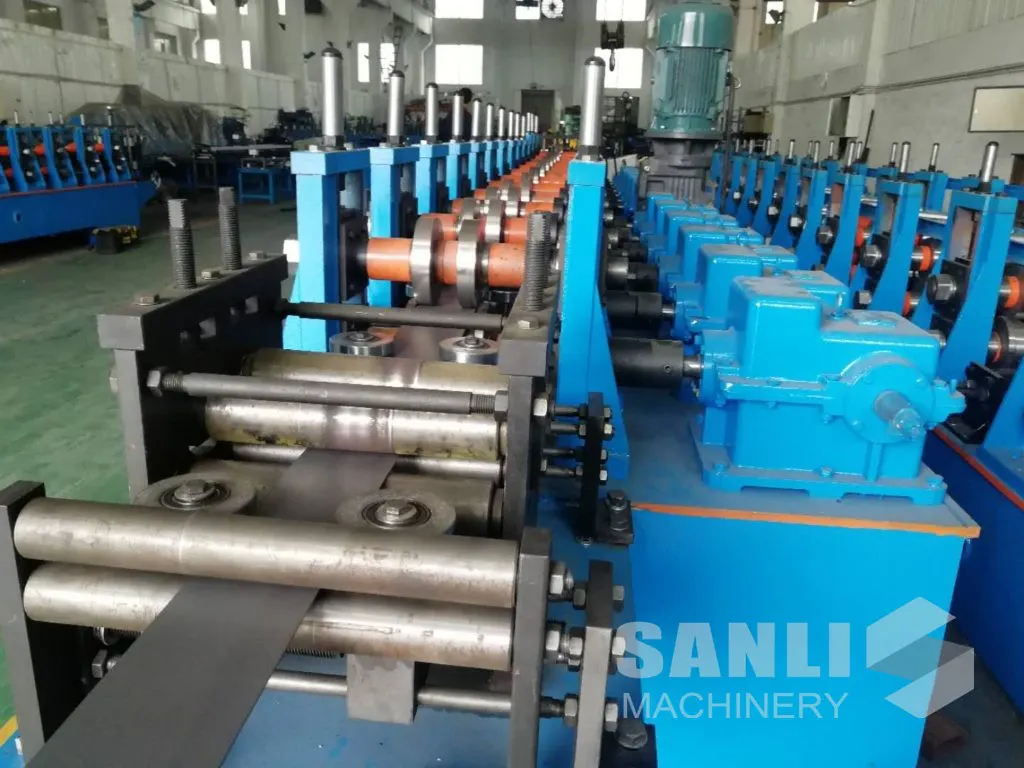
Rack Bracing Roll Forming Machine
13 stations at 1.4 – 1.8 mm — the highest part count in a cold store frame.
View machine -
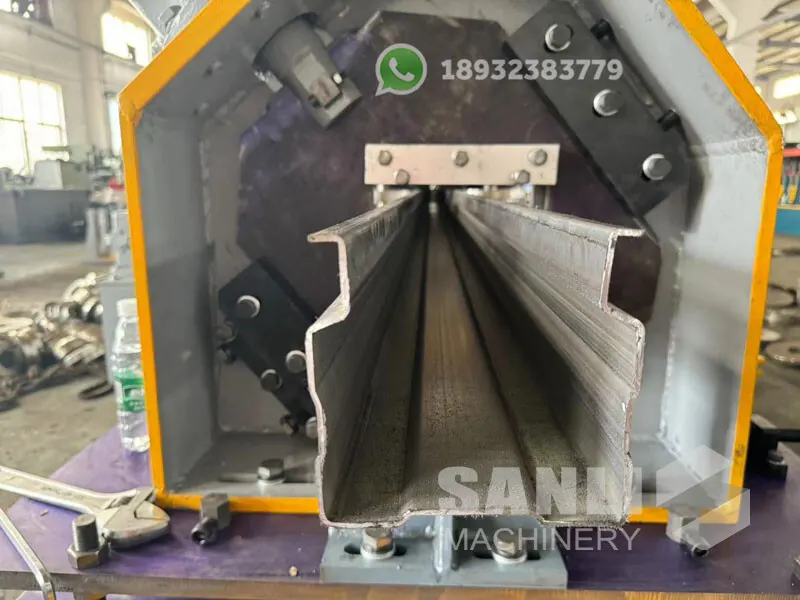
Heavy Duty Rack Upright Roll Forming Machine
For tall freezer columns: 20 stations, twin 22 kW, Cr12 rolls at HRC 58 – 62.
View machine -
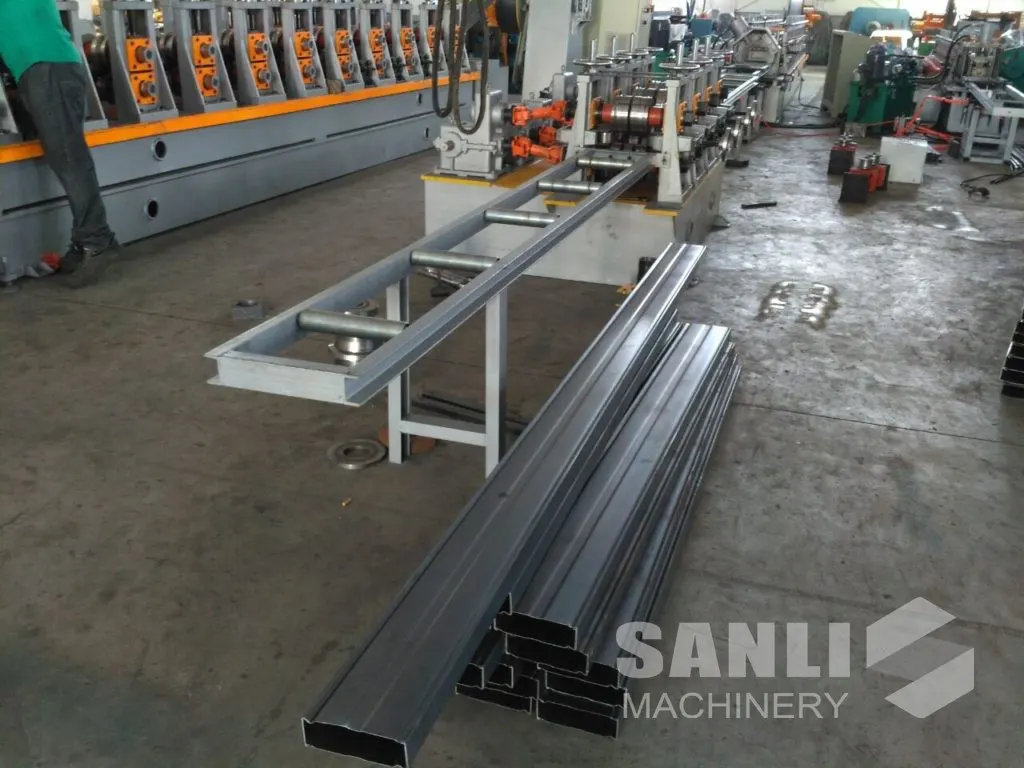
Rack Box Beam Roll Forming Machine
Beams at 1.5 – 1.8 mm, 14 stations, 22 kW — the same build as ambient work.
View machine
The other side
When the cold store label changes nothing
Not every refrigerated warehouse needs a different machine. These are the cases where it does not.
The rack is powder coated anyway
Some chilled (not frozen) installations use a coating system specified for the temperature. If the coating is already decided and it is not zinc, the machine is a standard build.
Only the decking is galvanised
Where the frame is painted and only the decking is zinc-coated, the forming line is unaffected — decking is bought, not formed on your line.
You subcontract the galvanising and the forming
If both steps are outsourced, buying a machine for a single cold store project puts the whole capital on that project. Tool up when the repeat orders exist.
Before you order
Questions this page usually raises
Does a cold store machine need a different roll material?
Not for temperature — the machine runs at ambient. The roll material is chosen for the strip being formed, and the change for galvanised work is the roll surface finish rather than the material: polished rolls and generous radii so the zinc coating is not marked or galled. On heavy builds that means Cr12 at HRC 58 – 62, finished accordingly.
Can the line form pre-galvanised coil without damaging the coating?
Yes, with the right roll finish and gap. The zinc layer is soft and takes marks from any roll that is not polished, and it is thicker than paint so the roll gap has to allow for it. Tell us at enquiry that the coil is pre-galvanised — specifying it after the roll set is designed means re-finishing rolls.
Is hot-dip galvanising done before or after forming?
After forming, which is why the machine matters less and the hole design matters more. Zinc fills small holes and bridges tight gaps, so holes have to be sized with the coating thickness in mind and the parts need drain points. The forming line itself is a standard build.
What steel grade is used for freezer racking?
That is a structural decision for the rack designer, not a machine decision, and it depends on the service temperature and the impact requirement the project specifies. The machine is specified around the grade you choose because yield strength changes the forming load. Send the grade with the enquiry.
Other selection guides
Selection guides
Head to head
Send the drawing and the output you need
The section drawing, the strip grade and the pieces per shift are enough to specify the machine — and enough to tell you if a different configuration would serve you better.